Tag: testimony

Testimony to joint committee on transportation on S.3077, “An Act to enhance the safe use of micromobility devices” (The Ride Safe Act)
Testimony to joint committee on transportation on S.3077, “An Act to enhance the safe use of micromobility devices” (The Ride Safe Act)

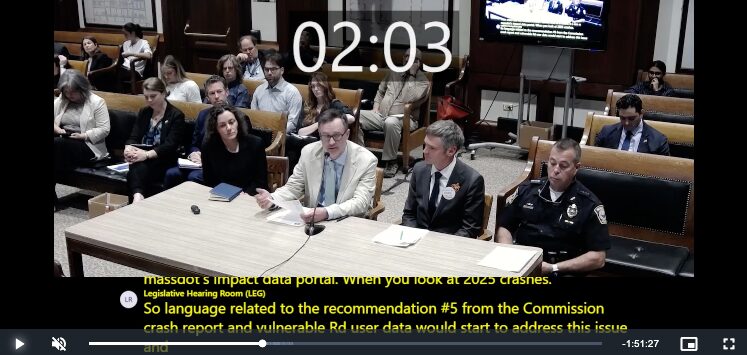
This testimony was shared at a Joint Committee of Transportation Hearing on May 28, 2026 as part of a panel with people that took part in the Micromobility Commission: (L to R) The Ride Cafe’s Kara Oberg, WalkMassachusetts executive director Brendan Kearney, MassBike executive director Galen Mook, and Beverly Police Chief Chief John G. LeLacheur.

My name is Brendan Kearney, and I’m the executive director of WalkMassachusetts, a statewide pedestrian advocacy organization, and our organization was a part of the commission. Thank you to Senator Crighton & Representative Arciero, all other members of the commission (including the rest of this panel), and to the staff at MassDOT who staffed the commission. I’m here in support of S.3077.

The majority of dangerous and fatal crashes in Massachusetts involve vehicles; at least 354 fatal crashes are listed in MassDOT’s IMPACT Data portal from 2025, and each involved at least one motor vehicle. 

One of the discussion points during the commission was that we don’t properly capture or report crashes that do not involve motor vehicles. 

Over the last year there have been some high-profile crashes and deaths involving micromobility devices, including a person walking that was struck by a delivery person using a class 2 e-bike in Boston’s Copley Square last August. That crash did not involve a motor vehicle and, as a result, it is not displayed in MassDOT’s IMPACT Data Portal when looking at 2025 crashes. Language related to Recommendation #5 from the Commission, “Crash Report & Vulnerable User Data,” would start to address this issue, and is included in this proposed bill in Section 23.

With more devices out and about (that will now be defined through this bill!), we should be able to collect data to capture crashes involving micromobility users either alone, with each other, or in crashes with people walking, even if a motor vehicle is not involved. 

I’d also encourage the legislature to look at the additional recommendations that are not included in this bill today and see what can be done to move them this session, or consider what should be prioritized in the near future. I’d like to highlight 3 of the 16 recommendations (starting on page 41), including: 

  • Recommendation 6,  Default Maximum 20mph Speed on Paths:
    This bill starts this process by defining shared use paths. I’d encourage you to take the next step to establish that default max speed. Whoever owns the path retains the authority to lower the limit.
  • Recommendation 8, Automated Enforcement or Safety Cameras:
    This would be for infractions that impact vulnerable users, such as speeding, the improper use of bus and bike lanes, and red light running. There are already bills that have been moving this session; the legislature should pass S.2344 and H.3754 to allow municipalities to opt-in to road safety cameras.
  • Recommendation 12, Funding for Upgrades and Expansion:
    The legislature should increase appropriations for existing state programs, particularly the Complete Streets Funding Program and the Shared Streets & Spaces Program, to further assist municipalities in expanding their networks and moving towards durable, physical separation for vulnerable users and/or overall traffic calming. 

WalkMassachusetts just led a community walk audit in Danvers last night alongside the Danvers Accessibility Commission and Representative Kerans. On it, we encountered kids selling lemonade on High Street, a busy road that connects to Rt 128. They (and their mom) shared that they aren’t allowed to cross High Street near the on/off ramps, but they would love to be able to walk or take their bikes and scooters to the trail which could be extended just 3 blocks away if it was safe to do that. It’d be a shame if their parents had to drive them there. Communities need funding to not just pave and put back what’s out there, but to plan and build for the future. 

Thank you for the opportunity to comment today.

Testimony to joint committee on transportation on S.2379, “An Act relative to providing multimodal transportation technologies” (AVs)

Testimony to joint committee on transportation on S.2379, “An Act relative to providing multimodal transportation technologies” (AVs)

Thank you to Chairs Arciero and Crighton and members of the committee for holding this hearing today. My name is Brendan Kearney and I am the Executive Director at WalkMassachusetts, a statewide pedestrian advocacy organization founded in 1990 as WalkBoston. I’m also sharing comments on S.2379, “An Act relative to providing multimodal transportation technologies,” which would authorize the use of autonomous vehicles in the Commonwealth. 

Separately, I’ll be submitting written testimony against the sidewalk robot bills, H.3773/S.2372 (“An Act relative to mobile carrying devices”), and in favor of Rep. Vitolo’s H3804 to give pedestrians more walk time, and Senator Brownsberger’s S.2343 expanding truck safety requirements. 

In 2024, there were 369 reported total traffic deaths in Massachusetts. At least 78 pedestrians lost their lives as a result of traffic crashes, accounting for just over 21% of the total. 

It is possible that self-driving vehicle technology may help reduce that number, but there is no guarantee. This must not be rolled out without proper safeguards for our communities.

Since there are many unknowns with autonomous vehicle systems, we caution you to err on the side of more data sharing, local control, and consultation so that MassDOT, regional planning agencies, and local transportation departments will know more about vehicles operating on streets across the Commonwealth, and ensure we’re adapting them to our communities instead of the other way around – and so that municipal staff are able to respond to safety issues and resident concerns. 

Incomplete crash data is a known issue. I encourage you to require data to be collected and shared not only during any testing phases, but also during deployment of autonomous vehicles. Please lean on the team at the MassDOT Safety Division who maintains the IMPACT Crash Portal to get their feedback on what information would be most useful to be collected and shared. 

A few data points AVs could provide beyond traditional crash data might include:

  • When and where vehicles are deployed to potentially understand the weather and road conditions the vehicles are driving in.
  • Close calls. These might include hard braking incidents (when the AV had to suddenly stop), disengagements (when the AV requires a safety driver to take over)  and immobilization (when the vehicle does not have a safety driver and is stuck).

I’ll share two concerns to keep in mind with the software:

  • 1st/ Intentional lawbreaking written into the code. In a Washington Post article in December titled “On roads teeming with robotaxis, crossing the street can be harrowing” their tech columnist in San Francisco captured videos of Waymo self-driving cars failing to stop for him at a crosswalk. He sought to answer the question, “How does an AI learn how to break the law?” A spokesperson for Waymo told him that its car might decide not to stop if adjacent cars don’t yield. “So is it possible that Waymo’s AI is learning from the human drivers on the road who also act like jerks?” One of the theories posited is that Waymo cars were intentionally getting more aggressive to help shed a market reputation for being slower than competitors.
    It is unclear to me how this behavior – violating the law to yield to pedestrians at a crosswalk – should be allowed, or how it would be creating a safer street than human drivers. The intentional lawbreaking that has been on display in California has also included short term parking in crosswalks and bike lanes – not pulling over to pick someone up, but remaining there for upwards of 5-10min. Communities and the state need to be able to collect data on that and have the ability to regulate it to hold companies accountable for these software choices.
  • 2nd/ Bias in the software itself. A study a few years ago from Georgia Tech found that “the facial and body recognition technology built into many pedestrian detection systems does not recognize and react to darker-skinned people as consistently as it does lighter-skinned people.” Already, people of color are disproportionately represented in fatal crashes involving people walking. The technology should level the playing field, not reinforce existing shortcomings and biases.  

Thank you for your time, I appreciate the opportunity to comment. 

This testimony was shared as part of a panel w/ Pete Wilson of Transportation for Massachusetts (T4MA) and Seth Gadbois of Conservation Law Foundation (CLF) at a Joint Committee on Transportation Hearing on June 24, 2025.

Testimony to joint committee on transportation on S.2344 & H.3754 “An Act relative to traffic regulation using road safety cameras”

Testimony to joint committee on transportation on S.2344 & H.3754 “An Act relative to traffic regulation using road safety cameras”

Thank you chairs Crighton and Arciero. My name is Brendan Kearney, and I’m the executive director of WalkMassachusetts, a statewide pedestrian advocacy organization working to make walking safer and easier in Massachusetts, to encourage better health, a cleaner environment, and more vibrant communities, originally established in 1990 as WalkBoston. I’m here alongside colleagues with the MA Vision Zero Coalition, who will speak to different aspects in support of H.3754 & S.2344. 

I want to give some context into some of the problems these safety camera bills are working to help solve. WalkMassachusetts releases a report each spring looking at fatal crashes from the year before. 

  • In 2024, there were 369 reported total traffic deaths in Massachusetts. At least 78 pedestrians lost their lives as a result of traffic crashes, accounting for just over 21% of the total. 
  • Of the 351 cities and towns in Massachusetts, 53 had at least one pedestrian crash death in 2024. 
  • 66.7% fatal pedestrian crashes took place in environmental justice census block groups. 

Environmental justice (EJ) is based on the principle that all people have a right to be protected from environmental hazards and to live in and enjoy a clean and healthful environment. This skewed spatial distribution of fatal pedestrian crashes in Massachusetts demonstrates that EJ communities face disproportionate harm in large part because of historic and present-day injustices in transportation planning, so we need to do more to protect the people that are just trying to get around or cross the street in their town. 

We’re grateful the legislature passed “An Act Creating a Next Generation Roadmap for MA Climate Policy” in 2021, which includes a specific definition of “environmental justice population” to ensure Massachusetts holds to this commitment no matter what is happening at the national level. 

Each year we’ve released this report, we believe that on the state and local level, there is a need for more action to slow drivers down so people trying to cross the street can do so safely. Drivers can more easily see and yield to people in crosswalks when driving slower. 

We were very glad that MassDOT Highway Administrator Gulliver testified earlier. 

MassDOT believes the need to slow people down to reasonable speeds as well – they now have an entire page of their website dedicated to Speed Management

In addition, the MassDOT Strategic Highway Safety Plan includes as one of six initiatives an effort to Accelerate Research and Adoption of Technology

“The Commonwealth is eager to support research and the use of technologies to reduce roadway deaths and serious injuries. As part of this work, Massachusetts will identify barriers to adoption, as well as the statutory and regulatory changes needed.”  

They specifically mention cameras for red light running, speed zones, and work zones. They cite that  “Automated speed enforcement can reduce fatal and serious injury crashes by 11% to 44% and reduce the proportion of  speeding drivers by 14% to 65%.” 

The governor’s budget bill also included safety cameras, so we hope this committee will move the safety camera bills in front of you along favorably. 

Thank you. 

This testimony was shared as part of a panel w/ Pete Wilson of Transportation for Massachusetts (T4MA), Galen Mook of MassBike, and Emily Stein of Safe Roads Alliance at a Joint Committee on Transportation Hearing on June 3, 2025.