The purpose of this walk assessment was to identify ways of improving the walking connections between downtown businesses along North Street, the Big
Y shopping area along West Street, and the newly constructed children’s carousel along Center Street and South Church Street. While the downtown sections of North Street and Columbus Avenue proved to be highly walkable, Center Street and West Street were less walkable with uninviting and potentially unsafe pedestrian conditions. The construction of the children’s carousel along Center Street will draw more families to this area. Developing greater pedestrian connectivity between the shopping areas and the residential areas to the north could reduce traffic congestion and promote a safer and more walkable area.
Today, Smart Growth America’s National Complete Streets Coalition unveiled their rankings for the best Complete Streetspolicies that were passed in the nation in 2015.
Complete Streets policies—including laws, resolutions, executive orders, policies, and planning and design documents—encourage and provide safe access to destinations for everyone, regardless of age, ability, income, ethnicity, or how they travel. “The presence of improved walkways and bicycle facilities encourages an active, healthy lifestyle and can lead to improved safety for all people, no matter how they travel through our cities and towns,” said Wendy Landman, Executive Director of WalkBoston. “At some point in every trip, everyone is a pedestrian.”
Congratulations to all the Massachusetts communities that passed Complete Streets ordinances in 2015, and especially the communities that landed on Smart Growth America’s best policies list: Longmeadow (tied for 3rd), Weymouth (4th), Ashland, Natick and Norwell (all tied for 7th), Lynn and Framingham ( tied for 9th).
While over 30 cities and towns in Massachusetts have already taken steps to implement Complete Streets, the new MassDOT Complete Streets Funding Program is helping to provide support to encourage even more cities and towns do so.
“The creation and implementation of the Complete Streets Funding Program has been a top priority for us and for our public health partners across the state,” said Rebekah Gewirtz, Executive Director of the Massachusetts Public Health Association. “Making it safe – and in some cases just plain possible – to walk, bike, and use transit will improve public health; complete streets are an essential tool to combat health inequities.”
In addition to health benefits, Complete Streets can boost the local economy by supporting local business districts and increasing property values. “Many municipal leaders see complete streets as an important contributor to quality of life in their communities,” said D.J. Wilson from the Mass Municipal Association. “They can encourage residents and visitors to shop locally, which help to attract and retain workplaces and employees.”
Walking rarely enters the conversation when new schools are planned. In fact, the regulatory and approval
processes focus on facilitating bus and automobile access to schools, and ensuring that there is sufficient
parking. Public meetings are usually dominated by those who complain about traffic volumes or inadequate
parking – not by those who seek a safe walking route to school. It happens in wealthy communities and low-
income communities alike. In most cases, it’s not that drivers are given priority over walkers, it’s that nobody
is thinking about walking. And that needs to change.
This report was prepared by WalkBoston for Mass in Motion, an initiative of the MA Department of Public Health.
Springfield Massachusetts is a city of approximately 153,000 people located about 90 miles west of Boston. The third largest city in the Commonwealth, Springfield is the cultural and commercial center of the Pioneer Valley.
This walk assessment occurred in the Metro Center neighborhood of Springfield, which has been called the business, government, and cultural center of the city. Bounded by Route 291 to the north, Union and Howard Streets to the south, Federal Street to the east and the Connecticut River to the west, Metro Center is home to historic residential streets, high-rise apartment and office buildings, and a downtown retail district. The neighborhood contains several cultural institutions, including the Springfield Armory, Symphony Hall, and the Quadrangle, which houses several world-class museums and the Dr. Seuss National Memorial Sculpture Garden.
by Nicholas Bulens, Grant Writer & Researcher, Town of Weymouth
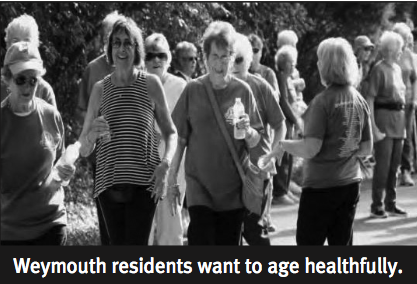
In the summer of 2014, WalkBoston partnered with the Town of Weymouth to open a conversation between municipal staff and older adults about creating a safer, more attractive walking environment. The Safe Routes for Seniors initiative was a true convergence of advocacy and policy, resulting in a set of design guidelines and program alternatives to better coordinate the town’s
capital planning process with greater walkability. The initiative has helped springboard Weymouth toward a healthier approach to community design.
Weymouth is a mature suburban community situated about 12 miles southeast of Boston. The town has a strong residential character with many attributes of a walkable environment. Weymouth has four village centers, each featuring a mix of land uses that helps create a sense of place for residents. It also has a diverse open space network interspersed among many settled neighborhoods. There is also a good mix of transit services, including commuter rail and bus, which help connect Weymouth’s people and places. However, in spite of these attributes, the town has grown increasingly dependent on the automobile for transportation in the last 50 years. Simultaneously, Weymouth’s population has aged and diversified to where almost one in every four residents is over age 60.
Recognizing a need to analyze the built environment from a healthy aging perspective, Weymouth received a grant from the Massachusetts Council on Aging, in partnership with the Massachusetts Department of Public Health [MDPH], to conduct a senior pedestrian safety study. Municipal staff collected data on Weymouth’s housing, land use and pedestrian crashes. The data led the town to identify four areas of need where seniors could most benefit from improved walking conditions.
WalkBoston facilitated a public meeting between municipal staff and an audience of over 30 older adults. Residents raised important concerns about poorly maintained sidewalks, obstructed lines of sight and distressed crosswalks. WalkBoston then hit the streets with a diverse focus group of municipal staff, senior residents and local businesspeople. A wealth of observations were made, and ideas flowed freely between stakeholders.
Weymouth’s walkability investigation culminated in the publication of the Safe Routes for Seniors Design Guidelines and Planning Report. WalkBoston introduced municipal staff to new and innovative approaches to streetscape improvements, including “lighter quicker cheaper” placemaking, which could facilitate safer, more frequent foot traffic by older adults in the town’s target areas. Weymouth’s planning staff prepared the final report to summarize the initiative’s findings and recommend design guidelines for town planning moving forward.
The Safe Routes for Seniors initiative has already led Weymouth to take a number of steps toward enhancing walkability. For 2015, Weymouth’s Mayor Susan Kay has committed $150,000 to sidewalk improvements and indicated that she will budget up to $250,000 for the same purpose each year thereafter. Plans are also under way by municipal staff to develop a Complete Streets policy and apply for certification under the MassDOT’s new Complete Streets program. In addition, the town has received a technical assistance grant from the MDPH to develop a zoning action plan with the Pioneer Valley Planning Commission [PVPC], a leader in the movement to design healthier communities. The PVPC will advise Weymouth on how to facilitate healthy eating and more physical activity in the community through changes to local zoning provisions, such as reduced parking requirements and site plan review.
This article was featured in our Summer 2015 newsletter. See the full newsletter & past editions here.
——————————————————————————————————————- Join our Mailing List to keep up to date on advocacy issues.