Testimony to joint committee on transportation on S.3077, “An Act to enhance the safe use of micromobility devices” (The Ride Safe Act)
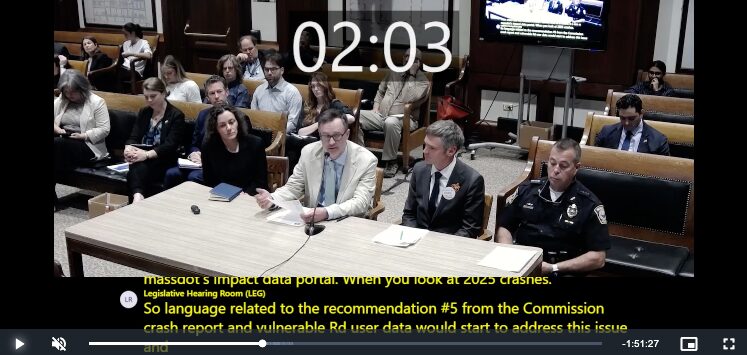
This testimony was shared at a Joint Committee of Transportation Hearing on May 28, 2026 as part of a panel with people that took part in the Micromobility Commission: (L to R) The Ride Cafe’s Kara Oberg, WalkMassachusetts executive director Brendan Kearney, MassBike executive director Galen Mook, and Beverly Police Chief Chief John G. LeLacheur.
My name is Brendan Kearney, and I’m the executive director of WalkMassachusetts, a statewide pedestrian advocacy organization, and our organization was a part of the commission. Thank you to Senator Crighton & Representative Arciero, all other members of the commission (including the rest of this panel), and to the staff at MassDOT who staffed the commission. I’m here in support of S.3077.
The majority of dangerous and fatal crashes in Massachusetts involve vehicles; at least 354 fatal crashes are listed in MassDOT’s IMPACT Data portal from 2025, and each involved at least one motor vehicle.
One of the discussion points during the commission was that we don’t properly capture or report crashes that do not involve motor vehicles.
Over the last year there have been some high-profile crashes and deaths involving micromobility devices, including a person walking that was struck by a delivery person using a class 2 e-bike in Boston’s Copley Square last August. That crash did not involve a motor vehicle and, as a result, it is not displayed in MassDOT’s IMPACT Data Portal when looking at 2025 crashes. Language related to Recommendation #5 from the Commission, “Crash Report & Vulnerable User Data,” would start to address this issue, and is included in this proposed bill in Section 23.
With more devices out and about (that will now be defined through this bill!), we should be able to collect data to capture crashes involving micromobility users either alone, with each other, or in crashes with people walking, even if a motor vehicle is not involved.
I’d also encourage the legislature to look at the additional recommendations that are not included in this bill today and see what can be done to move them this session, or consider what should be prioritized in the near future. I’d like to highlight 3 of the 16 recommendations (starting on page 41), including:
- Recommendation 6, Default Maximum 20mph Speed on Paths:
This bill starts this process by defining shared use paths. I’d encourage you to take the next step to establish that default max speed. Whoever owns the path retains the authority to lower the limit. - Recommendation 8, Automated Enforcement or Safety Cameras:
This would be for infractions that impact vulnerable users, such as speeding, the improper use of bus and bike lanes, and red light running. There are already bills that have been moving this session; the legislature should pass S.2344 and H.3754 to allow municipalities to opt-in to road safety cameras. - Recommendation 12, Funding for Upgrades and Expansion:
The legislature should increase appropriations for existing state programs, particularly the Complete Streets Funding Program and the Shared Streets & Spaces Program, to further assist municipalities in expanding their networks and moving towards durable, physical separation for vulnerable users and/or overall traffic calming.
WalkMassachusetts just led a community walk audit in Danvers last night alongside the Danvers Accessibility Commission and Representative Kerans. On it, we encountered kids selling lemonade on High Street, a busy road that connects to Rt 128. They (and their mom) shared that they aren’t allowed to cross High Street near the on/off ramps, but they would love to be able to walk or take their bikes and scooters to the trail which could be extended just 3 blocks away if it was safe to do that. It’d be a shame if their parents had to drive them there. Communities need funding to not just pave and put back what’s out there, but to plan and build for the future.
Thank you for the opportunity to comment today.