Tag: Boston

Lead a Jane’s Walk this May in your neighborhood

Lead a Jane’s Walk this May in your neighborhood

image

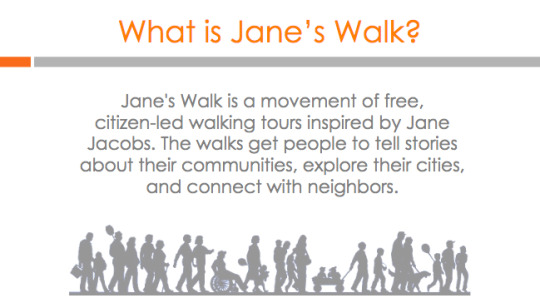
Jane’s Walk is happening the first weekend of May (5th-6th-7th).
Last year, 1,000+ walks happened all over the globe!

Think of this as an opportunity to:

  • start a conversation with your neighbors,
  • continue highlighting safety issues that have been identified through initiatives like Boston’s Neighborhood Slow Streets application process
  • get outside and enjoy a weekend in May!

Create your walk idea on Janeswalk.org, or get in touch with us at WalkBoston (contact Brendan!). We’re happy to help you or your neighbors with suggestions, promote your walk, and answer any questions you may have.
We look forward to helping you get out walking!

Edit: We’ll add neighborhoods/cities/towns below that will be hosting walks on this post (and include links to the separate walks within the communities as we find out about them.) 

Boston – West End – “Jane’s Walk West End Tour”
Meet at the West End Museum
Saturday, May 6, 2pm
http://janeswalk.org/united-states/boston/janes-walk-west-end-tour/

Boston – West Roxbury – “West Roxbury Walk Audit”
Meet at the Hastings Street Lot
Saturday, May 6, 2pm
http://janeswalk.org/united-states/boston/west-roxbury-walk-audit/

Boston – Jamaica Plain – “Growing the City: Washington St from Forest Hills to Green St”
Meet at Brassica Kitchen & Cafe
Sunday, May 7, 11am
http://janeswalk.org/united-states/boston/growing-city-washington-st-forest-hills-green-st/

Boston – Roslindale – “Roslindale Gateway Path & proposed Blackwell Path Extension”
Meet at SE corner of the Arboretum (look for Walk UP Roslindale Banner)
Sunday, May 7, 1pm
http://www.walkuproslindale.org/weblog/2017/04/21/janes-walk-planned-sunday-may-7-at-1-pm-start-at-the-southeast-corner-of-the-arboretum/

Cambridge – “The Dense Layers of History in Old Cambridge”
Meet at Out of Town News Kiosk, Harvard Square
Saturday, May 6, 10:30am
http://www.janejacobswalk.org/upcoming-2017-walks/the-dense-layers-of-history-in-old-cambridge

Worcester – Jane Week (May 1 – 7, 2017) gives Worcester residents and visitors a chance to connect to each other, explore Worcester by foot and participate in interesting discussions on how we can enhance the design and function of our city. – 20+ events and walks throughout Worcester.
http://janeswalk.org/united-states/worcester-ma/

Lowell – “Labor Movement in Lowell”
Meet at Lowell National Park Visitor Center, 246 Market St
Saturday, May 6, 10:30am
http://richardhowe.com/event/labor-movement-in-lowell-walk/

Dedham – “Walking Tour of Proposed Dedham Heritage Rail Trail”
Meet at the parking lot by the football field/track on Whiting Ave
Sunday, May 7, 4:00pm
Saturday, May 13, 10:00am
http://mailchi.mp/f20ef35375c4/rail-trail-happenings-this-spring

Somerville – “A Metamorphosis of Industrial Buildings Along the Rails”
Kickoff to Somerville’s Preservation Month, ending at Aeronaut Brewery
Saturday, May 13, 9:30am
http://janeswalk.org/united-states/somerville-ma/meta/

Boston – Jamaica Plain – “Walking Tour of Monument Square”
July 1 & August 19, 12:45pm
http://janeswalk.org/united-states/boston/walking-tour-o/

Comments on Sullivan Square/Rutherford Avenue Design Project 3/31/17

Comments on Sullivan Square/Rutherford Avenue Design Project 3/31/17

March 31, 2017

Deputy Commissioner James Gillooly
Boston Transportation Department, 7th floor
1 City Hall Square
Boston, MA 02201

Re: Sullivan Square/Rutherford Avenue Design Project (SS/RA Design Project)

Dear Deputy Commissioner Gillooly,

WalkBoston has been engaged in and following the planning and design of Sullivan Square/Rutherford Ave. for many years. We have consistently and persistently noted that the redesign of the streets and roadways for this part of Boston should reflect what the people of Charlestown, Somerville and Everett deserve as a hub for walking and transit, and should create opportunities for the redevelopment of what has long been a neglected, dysfunctional and unsafe auto-­centric wasteland.

We strongly believe that an at-­grade street system with opportunities for at-­grade redevelopment of parcels (that do not require air rights or decks) presents the greatest opportunity to create a sense of place, answer the long-­term transportation needs of this dense urban location, provide for safe mobility for all street users and allow for climate resilient designs.

Over the last decade transportation planners and engineers across the United States have come to understand that adding roadway capacity in multi-­‐modal, dense urban environments simply means that more people will drive their cars and fill up the roads. We’ve learned from years of mistakes that building large roads that look and feel like highways through communities encourages high speed traffic, attracts more vehicular traffic and traffic congestion, cuts off parts of neighborhoods.

The roadway, transit and sidewalk network at the heart of the Boston metro area should meet the multi-­‐modal needs appropriate to the land uses and neighborhoods that surround the roadway network. With I-­‐93 directly adjacent to Sullivan Square and Rutherford Avenue, this part of the region already houses a regional road system that serves longer distance travelers.

Slowing traffic down on Rutherford Ave and keeping regional traffic off of local roads will better protect Main St, Bunker Hill St and Medford St. the local streets are 1-­lane in each direction, with parking on both sides, and a number of traffic lights. It is counter-­‐intuitive to think that anyone might navigate off of Rutherford Ave and onto these streets in order to go faster. Waze and other similar tech services will always show drivers the fastest routes – if Rutherford Ave is faster than I-­93, Waze will route even more drivers through Charlestown.

The City’s new plan, Imagine Boston 2030 states the case that WalkBoston is making here: Sullivan Square has the potential to be “a walkable job and housing center with access to quality transit,” and goes on to note that this would require that “strategic infrastructure investment, potentially including open space, would be needed to address congestion and flooding vulnerability in Sullivan Square and nearby areas.”

The many comments that the City will receive about the project will provide both detailed technical and moving personal information about the project and its impacts on the Charlestown community. To put the project in a larger context, WalkBoston has reviewed the City’s plans for transportation (GoBoston 2030), resilience (Climate Ready Boston), and long range planning (Imagine Boston 2030). The table below puts the SS/RA in the context of the goals that these plans set for the City. We believe that the goals clearly point to the surface option as the right choice for the project.

If the City carries both options to further levels of refinement, we ask that several technical assessments be included:

1. Estimated number and severity of total traffic crashes for the entire roadway system from the Mystic River to Austin Street for each mode: pedestrians, bicycles, transit users and vehicles. We believe that the crash statistics cited on page 29 of the 2/28/17 slide show do not represent an accurate picture of the impacts of the project designs on all crashes. (see note below)

2. Measure the total land area devoted to roadway surface and “unbuildable” air rights parcels in each alternative.

3. Measure the longest distances that are not traversable by pedestrians between intersections: (1) from the bank of the Mystic River at Alford Street to the first pedestrian crossing, (2) from northern D Street south toward Baldwin Street), (3) north from Austin Street.

4. Estimate the walking travel time from the corner of Main and Bunker Hill Street to Sullivan Square Station.

5. Provide construction and fifty-­‐year operation/maintenance cost estimates for each proposal.

6. Describe in detail how vehicles using a Rutherford Ave tunnel will be slowed to 25-­‐30 mph when they emerge onto the surface portions of Rutherford Ave.

Let’s not put the design of Sullivan Square/Rutherford Ave on the wrong side of history. We don’t want to build new streets with underpasses that are “relics” before they are built.

Thank you for your consideration.

Best Regards,

Wendy Landman
Executive Director

Cc Chris Osgood, Chief of Streets, Transportation and Sanitation
Commissioner Gina Fiandaca, Boston Transportation Department
William Conroy, Project Manager Boston Transportation Department
Tad Read, Boston Planning and Development Agency
Peter Furth, Northeastern University
Amy Branger, Liz Levin, Emma Rothfeld Yashar, WalkBoston Board members and advocates from Charlestown

Note: Peter Furth provided WalkBoston with the following information about the cited crash statistics. “They are using Highway Safety Manual’s general 42% reduction in crash rate when an at-­‐grade intersection is converted to a grade-­‐separated interchange. It’s obvious, but worth emphasizing: a grade separated interchange is NOT what’s proposed for Sullivan Sq; what’s proposed is a flyunder, akin to a flyover. The HSM has no data on flyover / flyunder conversions. They are making a logical leap by using a reduction that comes from complete grade separation. On the slide they write “*Applies to Underpass Movements Only,” meaning they intend to apply that reduction only to cars who will use the underpass. However, that suggests that a flyunder will leave all the other traffic unaffected. That is not proven (there is no data), and moreover, there are good reasons to expect that crash rate will go *up* for the other traffic. One reason is that the only traffic removed by the flyunder is thru traffic; all the turning traffic, which carries higher crash risk, remains, and furthermore will be concentrated. More importantly, the space required for the flyunder structure forces the at-­‐grade intersection to have an unfavorable geometry, with the left turn lanes that flank the underpass separated from each other in a way that results in interlocking left turns, which are less efficient and (probably) less safe. Nobody would ever lay out an intersection that way if they weren’t constrained by the structure of the flyover / flyunder. That change could have an unfavorable safety effect that erases the gains enjoyed by thru cars that get to bypass the intersection.”

Congrats to this year’s Golden Shoe Award Winners!

Congrats to this year’s Golden Shoe Award Winners!

As presented at this year’s annual event on March 29, 2017

See the list of all time winners:
https://walkmass.org/events/goldenshoe-award

Alison Pultinas | Persistent, effective Mission Hill/Roxbury citizen activist
Alison Pultinas is a leading Mission Hill activist and a key member of the Friends of Melnea Cass Boulevard. Alison has been a guiding hand for the design of the Melnea Cass roadway as it has evolved from a roadway widening project to a Complete Street. Throughout the five-year advocacy effort, Alison has been persistent and effective, providing key institutional memory, recalling comment letters sent and informal decisions reached.
Alison is a strong advocate for development that is not dependent upon automobiles. She is a key ally of WalkBoston and consistently encourages WalkBoston to attend meetings and to respond to projects, like the proposed Tremont Crossing mixed-use development. She keeps watch over several of the outdoor stairways which connect walking routes on the hilly landscape of Mission Hill, cleaning and shoveling when needed. Alison is happy to report that the reconstruction of the Hayden Street Stairs, a City of Boston Public Works project, is upcoming. She also writes for the monthly community newspaper, The Fenway News, with a focus on development and historic preservation issues.

Sarah Bankert, Healthy Hampshire | Rural walking advocate in Western Massachusetts
Sarah Bankert conceived of the Route 202 – Common to Courthouse Corridor Study in Belchertown, which brought together municipal staff, Belchertown seniors, and economic development entities to work toward a shared goal of a safer, higher quality walking experience along Route 202. Sarah and her team’s efforts attracted the attention of the American Institute of Architects (AIA) Design & Resiliency Team (DART) who conducted a multi-day workshop which resulted in a “Three Villages & A Farm: Belchertown Beyond” case study report. She is also leading efforts to improve health and walkability in 14 towns in Hampshire County as part of the MDPH 1422 grant.

Caitlin Marquis, Healthy Hampshire | Rural walking advocate in Western Massachusetts
Caitlin Marquis has been a committed voice for incorporating physical activity – particularly walking – into town-wide planning efforts in Williamsburg. She contributed to the formation of the Facilities Master Plan Committee, plays an advisory role with seniors at the Williamsburg Council on Aging, and promotes healthy food choices at the local town center market. Her efforts demonstrate how walkability permeates so many aspects of the daily lives of Williamsburg residents. Caitlin also works to improve health and walkability in 14 towns in Hampshire County as part of the MDPH 1422 grant.

Dillon Sussman, Pioneer Valley Planning Commission | Rural walking advocate in Western Massachusetts Dillon Sussman, a land use planner at the Pioneer Valley Planning Commission (PVPC), has also brought walkability to the rural towns of Hampshire County. Dillon conducted a Health Aging and Community Design regulatory review in Williamsburg and directed the town’s Facilities Master Planning efforts. He also authored the adaptation of PVPC’s Healthy Community Design Tool-Kit to include age-friendly design elements that are applicable across the Commonwealth.

Michelle Wu, Boston City Council President
Boston City Council President Michelle Wu has elevated the conversation about walking (and bicycling and transit) at the City Council, in City Hall, and among many Bostonians. Her proactive efforts to reach out to WalkBoston and many of our fellow activists about the importance of making Boston safer for people walking in the City has helped keep active transportation efforts alive in Boston. Partnership with Councilor Wu is particularly powerful as we work with many City departments, grassroots organizations and residents to implement Vision Zero.

————————————————————————————————
Join WalkBoston’s Mailing List to keep up to date on advocacy issues.

Like our work? Support WalkBoston – Donate Now!
Connect with us on Twitter and Facebook

Comments on the Seaport Square NPC, MEPA 14255-3/24/17

Comments on the Seaport Square NPC, MEPA 14255-3/24/17

March 24, 2017

Matthew Beaton, Secretary
Executive Office of Energy and Environmental Affairs
Attn: MEPA Office Analyst: Alex Strysky
100 Cambridge Street, Suite 900
Boston, MA 02114

Gary Uter
Boston Planning and Development Agency
One City Hall Square
Boston, MA 02201

Re: Comments on the Seaport Square NPC, MEPA 14255

Dear Mr. Beaton and Mr. Uter:

WalkBoston is pleased to submit comments on the revised Seaport Square project in the South Boston Seaport District.

We applaud the developer’s broad and thoughtful approach to creating a walkable and pedestrian focused sense of place. In particular, the new walking connection to Summer Street; the extensive, interesting and continuous connection to the harbor via Harbor Way; and the fact that the development is at the same grade with the rest of the Seaport District provide great opportunities to help transform the district into a lively part of the City.

Our comments are focused on several detailed design and management issues that we believe should be further considered as the project moves toward final development and implementation.

  1. We are very pleased that the proponent is providing an additional entrance to the Courthouse Silver Line station. This will provide weather-­protected access to transit and provide very convenient transit access for people walking in the area. We urge the developer to ensure that safe crosswalks are provided to the Silver Line station on Northern Avenue and on the nearby intersecting streets -­ Marina Park Drive and Boston Wharf Road -­ two cross streets that are not precisely aligned with one another. The crosswalks should serve desire lines for walkers going to or from the station.
  2. Several of the key pedestrian crosswalks that will serve the project require further attention to pedestrian safety.
  • The lane widths shown on Figures 1-­35 and 1-­36 show that Congress Street and East Service Road will have overly wide 12’ and 15’ travel lanes. The un-­‐signalized pedestrian crosswalk on Congress Street is 70’ wide and we believe that substantial safety measures are needed to make this a safe place for pedestrians, in particular because many of the vehicles using this street will be coming from or heading toward I-­90, a situation that causes drivers to think that they are in a higher speed situation. Among the measures that should be considered are: addition of a traffic signal, narrowing the lanes and the crossing distance, and addition of a raised crossing.
  • The diagrams of other streets show 10.5 – 11’ foot lanes. We urge the proponent to work with the City to shrink all lanes to 10’ or 10.5,’ which the City’s Complete Streets Guidelines suggest as a reasonable width for an urban street.
  • At the edge of the project, a crossing of Summer Street to connect Seaport Square with the BCEC is absolutely essential. This crosswalk must be fully protected by a traffic signal. We believe that a gracious and safe pedestrian crossing of Summer Street will be important to the financial success of Seaport Square in addition to fulfilling the needs for a walker-­‐centric design.
  • No signals are provided for five pedestrian crossings of Northern Avenue. While this may be viewed as a slow-­‐moving street, great care should be taken with the design to ensure that all the crossings are safe for pedestrians, with minimal crossing distances and street designs and parking management that ensure that pedestrians waiting to cross can be seen by approaching motorists.
  • It is noteworthy that signalized crossings are added along Seaport Boulevard at pedestrian crossings between Farnsworth Street and the Harbor Shore Drive pedestrian way, between Thompson Street and Fan Pier Boulevard, and at the important pedestrian crossing where the Summer Street–to-­‐harbor pedestrian way intersects the Seaport Boulevard and also leads to the new entrance to Courthouse Station on the Silver Line.
  1. The shadow conditions in the project area suggest that the proponent will need to make special provisions to make the pedestrian zones comfortable during colder parts of the year. The developer might look to some of the work highlighted by WinterCities (http://wintercities.com/home/about/) for ideas on this topic.
  2. The proposed design for Seaport Boulevard as shown in Figure 1-­6 does not yet accomplish the goals for a truly walkable urban district. Except for a partially widened median strip, the roadway appears to have few distinctions from the existing conditions. Among the measures that should be considered for Seaport Boulevard are:
  • Narrow lanes and frequent raised crossings to slow traffic
  • Pedestrian scale lighting
  • Activated ground floor uses to give a sense of place for people walking along the street •  Pedestrian wayfinding
  • We also urge the proponent to consider whether a widened median is a desirable design feature to be continued throughout the project area. The landscaping with rocks, grasses and sculptures might truly make the boulevard distinctive. Landscaping features could also be added on the sidewalks, making the walking experience more pleasant.

All of the design features noted above could help shift the street from its existing character as an auto-­centric roadway to one that is attractive and safe for pedestrians.

  1. The proponent should consider walking conditions and amenities on the edges of the project as well as the center – people will be walking everywhere and the NPC is focused very heavily on the central Harbor Way. We urge that the many other streets be carefully planned as well.
  2. Because the project is so large and will create a significant portion of the Seaport District’s character, it seems to have the potential to provide a pedestrian and land use environment that can serve a diverse and multi-­‐generational population. We urge the developer to pay attention to the mix of uses, shops and restaurants and their pricing so that they are attractive to all members of the greater Boston community.
  3. Bicycle accommodations shown in the NPC do not seem to represent Boston’s current thinking about the need to provide low stress bicycle facilities. While this is not WalkBoston’s area of expertise, we believe that it is very important for the Seaport District to accommodate bicycles as well as possible.
  • For example, Figure 3-­13, Transportation Circulation Plan, shows bicycle lanes on Northern Avenue, Seaport Boulevard and Boston Wharf Road, without indicating connections to the City’s planned bicycle routes on Congress Street, Summer Street, the Northern Avenue Bridge, the Evelyn Moakley Bridge, and Seaport Boulevard east of East Service Road. Potential north-­‐south connections between these main routes are ignored. Possible bicycle lanes on Sleeper Street, Fan Pier Boulevard, Marina Park Drive or other connecting streets are not indicated.
  • Bicycle lanes on Seaport Boulevard are shown in ways the City is no longer supporting. Figure 1-­6 shows bicycle lanes adjacent to moving traffic, while the City is now working to provide protected bicycle lanes (between parked cars and the sidewalk) on arterials.
  • The crosswalk on Summer Street will also be used by cyclists on the Summer Street cycle tracks. Cyclists will be interested in crossing the street as they access the proposed development – particularly the critical and focal pedestrian path between Summer Street and the harbor. Special provision for cyclists should be included to preserve the safety of pedestrians throughout this potentially densely used walkway.


Thank you for the opportunity to provide comments on the project, and would be pleased to answer any questions that our comments raise.


Sincerely,

Wendy Landman
Executive Director


Cc Yanni Tsipis, WS Development
Jonathan Greeley, BPDA
Vineet Gupta, Boston Transportation Department
Patrick Sullivan, Seaport TMA


Pricier Boston parking meters is a start

Pricier Boston parking meters is a start

AS PUBLISHED IN BOSTINNO ON JAN. 18, 2017 

Brendan Kearney is the Communications Director at WalkBoston and a member of the Boston Vision Zero Task Force. 

The City of Boston recently rolled out a performance parking initiative that includes flexible parking meter pricing in the Seaport and Back Bay. Prices will be lower on streets that consistently have availability, while the meter price will be higher on streets that are often filled. You may be able to park a little farther away to save a few quarters, which frees up a spot closer for someone who needs it – or doesn’t mind paying a little more.

Kudos to Mayor Marty Walsh. The city is on the right track with a pilot project like this one. Boston is home to an innovation economy. We should be pushing for more pilot projects to change how our streets and curbside spaces are allocated.

If modifying the price of parking can help change habits, all the better. People may realize that for many of their daily trips, it is cheaper and more convenient to walk, take the bus/train, or bike, leading to fewer cars on the road and endless searches for a spot curbside. Boston should also follow the lead of surrounding communities like Cambridge ($25), Somerville ($40), Brookline ($25) and Quincy ($20) offering annual residential parking permits to help pay for city services.

The Boston Globe’s Dante Ramos makes the argument that the new meter price isn’t nearly high enough, and it is hard to disagree with his logic: “Before Boston adopted the current rate in 2011, the city had charged curbside parkers $1 an hour for the previous 30 years. By comparison, MBTA subway fares rose from 60 cents in 1982 to $2.25 today. Had meters merely kept up with inflation since 1981, they’d cost $2.66 an hour citywide.”

While cities and towns don’t control the MBTA, the cities and towns do control most of the streets and signals. The City of Everett debuted a bus-only lane in December during the morning rush hour, helping to speed the trips along a busy corridor. A similar pilot on Summer Street in South Boston would be well worth a try. Stacy Thompson at LivableStreets Alliance says “[buses] can be awesome, and they should be fun.” More pilot projects for bus corridor improvements can help with that.

Transportation for Massachusetts (T4MA) released a report in October titled “Fast Forward” giving a snapshot of transformative changes in transportation and how they could play out in Massachusetts. One key takeaway of the report: “Walking – along with biking and transit use – allows vast numbers people to navigate tight urban spaces without contributing to congestion, supporting the vibrant mix of businesses, amenities and housing that make Massachusetts’ cities special. No innovative mobility solutions work for the urban core, therefore, unless they enable and foster walkability.”

Let’s not be afraid to try out new solutions on our streets, which may just be new to us, of course; many cities around the United States have been trying out pilot projects to improve transportation. The goal shouldn’t be innovation for innovation’s sake, but to find ways to make our cities a better place for more people to work, live, and play – no matter how they are getting around.

This article was featured in WalkBoston’s March 2017 newsletter.
————————————————————————————————
Join WalkBoston’s Mailing List to keep up to date on advocacy issues.
Like our work? Support WalkBoston – Donate Now!
Connect with us on Twitter and Facebook