Category: Announcement

WalkBoston Receives $165,000 Grant from Point32Health Foundation

WalkBoston Receives $165,000 Grant from Point32Health Foundation

WalkBoston was awarded a three-year $165,000 grant from Point32Health Foundation to advocate for policies that support, advance and result in age- and dementia-friendly walkable communities.

“WalkBoston is a leading advocate on transportation issues important to older adults and a strategic partner to the Massachusetts Healthy Aging Collaborative. The grant will support WalkBoston’s work to engage older people in walk audits in communities with significant needs and train new advocates. The new trainers will collaborate with state and local agencies to share the data and advocate for transportation solutions that support healthy aging in communities across the state.”

Building on the legacy of service and giving established by Harvard Pilgrim Health Care Foundation and Tufts Health Plan Foundation, Point32Health Foundation works with communities to support, advocate and advance healthier lives for everyone. This is one of 10 new community investments to organizations in Connecticut, Massachusetts, New Hampshire and Rhode Island totaling more than $1.1 million. The grants support community-led solutions to remove barriers that perpetuate inequities and advance policies and practices that create more inclusive communities 

“The pandemic has revealed significant gaps in our transportation, housing and food systems that disproportionately affect older people and communities of color,” said Nora Moreno Cargie, president of Point32Health Foundation and vice president for corporate citizenship at Point32Health. “To create communities that work for everyone, policies should honor and reflect community voices.”

About Point32Health Foundation

Building on Harvard Pilgrim Health Care Foundation and Tufts Health Plan Foundation’s values of service and giving, Point32Health Foundation works with communities to support, advocate and advance healthier lives for everyone. The Foundation advances equity-focused solutions in healthy aging, access to healthy food and behavioral health in Connecticut, Maine, Massachusetts, New Hampshire and Rhode Island.  Follow us on Twitter and Facebook.


Board Spotlight: Welcome Tony Wain and thank you to our departing board members!

Board Spotlight: Welcome Tony Wain and thank you to our departing board members!

We are excited to welcome Charles Anthony “Tony” Wain as a new WalkBoston Board member!

Prior to joining us he was a Senior Lecturer at Babson College in Accounting & Law. He also spent 30 years working in financial and management consulting for Touche Ross & Co. (now Deloitte) and Digital Equipment Corporation. His areas of interest are business modeling and financial planning and analysis. Tony was a two-term member of the board for Community Action Partners (CAP) of the Harvard Business School Association of Boston and is a Trustee and Treasurer for the Native Plant Trust (formerly New England Wild Flower Society). He currently consults through CAP with non-profit agencies in the areas of general management, business plan development and management control systems.

We also want to take this moment to express our gratitude to our outgoing board members: Amy Branger, Erik Lund, and Greg Rogers for their leadership and guidance over the years.

Thank you for helping us make Massachusetts a safer and more walkable place!

Boston University video storytelling partnership: tell your story!

Boston University video storytelling partnership: tell your story!

WalkBoston is excited to partner with Boston University’s Cross-College Challenge (XCC), BU Hub’s interdisciplinary project-based elective course open to upperclassmen. The XCC engages students in team projects that address a real-world problem or an enduring human question — students in the course will utilize video storytelling to explore walkability and mobility through diverse perspectives. 

WalkBoston began the project by giving students a Ped 101 presentation to establish a walkability knowledge base. We’re now looking for participants who live, work, or walk around the City of Boston (or within a 10-15 minute transit ride of the City) to be interviewed by the students. 

These interviews and documentaries are looking to capture what walking and mobility looks like in an effort to reframe how these terms are understood and defined in the mainstream and by those with power — to encourage a more intersectional and justice-focused approach to mobility. In particular the project aims to capture perspectives from those who have been historically excluded from the transportation discussion (e.g. BIPOC, LGBTQIA+, low income, undocumented, disabled, non English speakers, and more). If you or someone you know would like to share your experiences navigating the public realm through walking (or not walking), please reach out to us at info@walkboston.org by February 25th. 

As part of this project, participants will need access to Zoom to engage in a preliminary interview and, if comfortable, be filmed while walking (or attempting to walk) in and around Boston during the month of March. Participants who speak languages other than English are encouraged to participate, as interpretation and translation will be available for all involved. 

Participants will be compensated with a $25 gift card for their time and will have final approval over what is published from their interviews. Participants under 18 are welcome, though a guardian’s release will be required. 

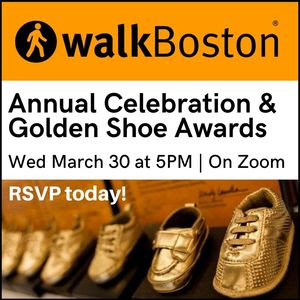
Save the Date: Annual Celebration 3/30, 5pm

Save the Date: Annual Celebration 3/30, 5pm

Join us on March 30th (on Zoom) to celebrate & honor this year’s Golden Shoe winners!

Each March, we hold our Annual Celebration to celebrate achievements in walkability and to highlight the contributions of our wonderful volunteers, board members, and the many individuals and corporations who support us every year.

The presentation of our Golden Shoe Awards is an integral part of the Annual Celebration. The Golden Shoes recognize individuals, agencies, municipalities and companies exemplifying the ideals of WalkBoston’s mission. 

More info on this year’s honorees and speakers coming soon, but registration is now open!

October Speed Workshop Recap

October Speed Workshop Recap

Earlier this month, we held a 90- minute lunchtime workshop on speed limits and community advocacy around speed mitigation where we discussed the many speeding issues communities across the Commonwealth are facing. This workshop was made possible thanks to funding from the Plymouth Rock Assurance Foundation.

The slides we shared at the beginning of the workshop can be viewed here. Below we’ve summarized the breakout sessions, included links for some of the questions that were posed during the discussion so you can learn more, and added a list of funding sources that places across Massachusetts can use to improve pedestrian safety in their community. 

PROBLEMS: “What speed setting problems are you facing?”

  • Road Jurisdiction: who controls the road? State agencies (MassDOT, MassDCR) set the speed limit on roads they control, which may be at odds with what the community wants. These roads are also not subject to a community’s opt-in to 25mph speed limit
  • Discrepancies between design speed and posted speed limit. If when repaving or reconstructing a road the design speed selected is higher than the posted speed limit, it encourages people driving to drive faster. If a speed study is done after paving, even higher speeds may be observed, leading to a higher posted speed limit. 
  • Blanket Speed Limits that don’t match the local context and land use. If there is a blanket 25mph limit but a road is designed for higher speeds, it gives a message to people driving that the speed limit can be ignored. 
  • Only posting speed limit signs for the default 25 mph speed limit at municipal lines can be confusing. A few examples people offered:
    • A person could drive an entire trip within a community and never see a speed limit sign for the default speed, since it is not allowed to be posted anywhere other than at the municipal line.
    • Mixed messaging – there can be a sign w/ a different speed limit almost immediately after the default speed limit sign at the municipal line if that particular road had a speed study for a higher speed limit. 
    • Even when using a speed feedback sign that displays a driver’s speed, we have been told that we can’t post the white/black speed limit sign along with it to show the default speed limit. 
  • The 25 mph opt-in legislation leaves out many rural municipalities since it is meant to include ‘thickly settled areas.’ What can be done for communities that have areas that don’t fit the definition of ‘thickly settled’? 

Interventions and Strategies

  • Speed Feedback signage. Speed feedback signs can cue drivers to slow speeds, and can be periodically moved around to different areas where they may be useful. Complete Streets funding is one method to purchase speed feedback signs.  
  • Utilize speeding ticket revenue for improvements around the immediate area. In Salem, revenue generated from parking tickets issued for infractions that occur in accessible parking spaces is directed towards the disability commission. As with this example, revenue generated from speed ticketing can be used to help fund streetscape improvements that slow speeds and increase safety in the area where the infraction occurred.
  • Piggyback on upcoming investments. When changes and investments are about to be made, seize the opportunity to work with the City, DCR, MassDOT or whichever party has jurisdiction over the road, and ask for additional changes at the project site that advance best practices for traffic calming and can be made concurrently.
  • Use multiple strategies, even if low-cost. Singular built environment changes are seldom as effective as making multiple, complementary streetscape changes that provide drivers with repeated cues to slow down. In-street signage, advanced yield signs, striping, and flex posts and painted curb bump outs are all inexpensive interventions that can be affordably implemented together to slow speeds. See our report on low-cost traffic calming strategies for more. 

Advocacy