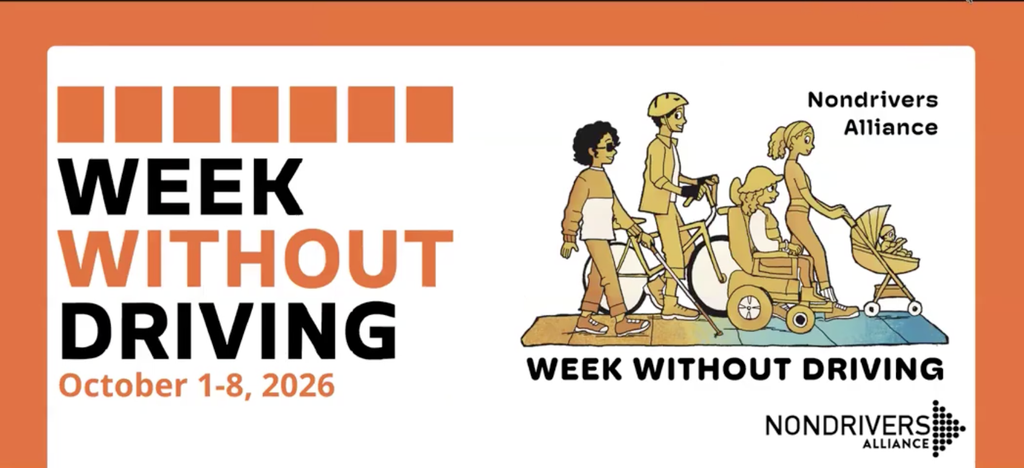
What is “Week Without Driving”?
Week Without Driving was originally launched by the Disability Mobility Initiative (a program of Disability Rights Washington) under Anna Zivarts. In 2023, America Walks stepped in to organize the initiative nationally, and today it is led by the Non-Drivers Alliance.
The effort isn’t about shaming drivers or demanding everyone abandon their vehicles forever. Instead, it serves as a tool for experiential learning, reflection, and policy change built on three core principles:
- Dignity & Access to Life: Everyone deserves the freedom to travel safely where they need and want to go.
- Equitable Transportation: Those who walk, roll, cycle, or take public transit every day are the real experts on gaps in local infrastructure.
- Justice: Mobility barriers disproportionately impact low-income individuals, communities of color, and people with disabilities.
From Experience to Advocacy: Why Storytelling Matters
A central takeaway from Ruth’s presentation is that transport network gaps become glaringly obvious the moment you step out of a personal vehicle. While transportation discourse often separates walking, biking, and transit, the lived reality of a non-driver intersects with nearly every aspect of civic life—housing, health care, and climate action.
Uncovering Hidden Needs
When decision-makers experience transit firsthand, policy priorities shift. Ruth shared an instance where a city council member invited a mayor on a bus ride along during Week Without Driving:
“The mayor went, and they missed the bus. They were late to the City Council meeting, but in that, the mayor also got sunburnt. The mayor realized, ‘Oh, this is why you need bus shelters.’ It didn’t click as a necessity before—it seemed like a ‘nice-to-have.’ But when you’re waiting for more than 5 minutes, you feel the heat, the rain, or the snow.”
Grassroots Actions Across the Country
Communities have adapted the initiative to address local transit challenges in creative ways:
- Spokane, Washington: Activists secured free lumber and built 27 bus benches across the city where seating was completely absent.
- Pittsburgh, Pennsylvania: Advocates organized press conferences during the week to highlight impending transit budget cuts and rally support for public funding.
- Rural Communities: Research interviews uncovered how non-drivers in rural areas face unique gaps, such as a lack of ride-share availability on Sunday mornings for church services due to late-night shifts the evening prior.
Rapid Growth & Local Impact
Rather than operating top-down, the campaign empowers local “community leads”—which include non-profits, transit agencies, regional planning commissions (MPOs), and individual advocates—by providing customizable media templates, outreach graphics, and storytelling guides.
In places like Worcester, Massachusetts, local organizers are entering their third year of hosting Week Without Driving events, using the momentum to build partnerships with elected leaders and secure regional sponsorship.
The Intersection of Data and Lived Experience
Looking ahead, the Non-Drivers Alliance is expanding its research efforts in partnership with institutions like UC Davis, the Climate Community Institute, and Transit Center. A primary focus is equipping advocates to pair hard data with personal storytelling.
While statistics show transit gaps on paper, pairing a data point with a human story transforms abstract numbers into actionable policy decisions. As federal funding fluctuates and local budgets face pressure, keeping these personal narratives at the forefront ensures that mobility remains recognized not as a luxury, but as a fundamental lifeline.
Learn more about Week Without Driving and watch the recording of this WalkMass network here.
Blogpost by Emma Itri, Dev + Comm Manager.