Category: Newsletter

The key to BRT success? Walking.

The key to BRT success? Walking.

Joseph Cutrufo is a former member of the WalkBoston staff and current Director of Communications and Connecticut Policy at Tri-State Transportation Campaign.

In March 2015, Connecticut cut the ribbon on CTfastrak, New England’s first bus rapid transit system. CTfastrak features a 9.4-mile bus-only guideway which runs from downtown New Britain through Newington and West Hartford to its terminus in downtown Hartford.

CTfastrak has outpaced ridership projections so far. But the real test for CTfastrak will be whether it can transform the way people travel in greater Hartford, where 81 percent of commuters drive to work alone — even higher than the national average of 76 percent.

Not long after the system launched, prospective riders bemoaned the lack of parking near stations. Predictably, the Connecticut Department of Transportation responded by building more parking.

But when people won’t use the system due to a lack of parking, we shouldn’t ask, “Where can we build more parking.” We should ask, “Why can’t people get here without a car?” In greater Hartford, the answer is simple: the neighborhoods surrounding CTfastrak stations aren’t dense enough, and the streets in station areas don’t safely accommodate walking.

Some in the CTfastrak corridor recognize these challenges. The City of New Britain hired a consultant to run a series of public workshops to identify what kind of developments would be most appropriate for the city’s three CTfastrak stations. And in West Hartford, town officials amended local zoning regulations to allow mixed-used development around CTfastrak stations, where much of the land is currently zoned for industrial uses.

But in suburban Newington, the town’s zoning board passed a moratorium on “high density development” shortly after CTfastrak service launched.

Connecticut Governor Dannel Malloy has set aside funds to help speed along transit-oriented development projects, but ultimately the region needs a more holistic approach to making greater Hartford a more walkable region. The state had a chance to start the process through legislation in 2015, but a bill proposing a “Transit Corridor Development Authority” was viewed unfavorably by towns that saw it as a threat to home rule.

That won’t be the end of the movement to unchain the greater Hartford area from car-dominant planning. One place to look for inspiration is the city of Hartford, where a major zoning overhaul seeks to undo a half-century in which the city’s parking inventory increased by 30,000 as the population declined by 40,000 people.

This article was featured in WalkBoston’s January 2017 newsletter.
————————————————————————————————
Join WalkBoston’s Mailing List to keep up to date on advocacy issues.
Like our work? Support WalkBoston – Donate Now!
Connect with us on Twitter and Facebook
A newcomer’s guide to a walkable lifestyle

A newcomer’s guide to a walkable lifestyle

Tom Palmer covered transportation and real estate development for 15 of his 32 years as a reporter and editor at the Boston Globe. He now owns Tom Palmer Communication, a consulting firm.

I’m a newcomer to Boston. I’ve only been here 40 years. The city has changed a lot in that time, but one thing hasn’t changed. It’s still a walkable city. My friends from the Midwest, and even some who visit from bigger cities closer to us, are invariably pleasantly surprised at how accessible and manageable it is. “I love Boston, because you can walk across town in 45 minutes,” a visitor told me.

There’s a lot of room for improvement, of course. Our walk/don’t walk/take-your-life-in-your-hands lights could be better. Pedestrians could shape up by paying attention to lights, but the streets are often so narrow it’s often tempting to make a run for it.

Another thing that hasn’t changed in my short time living in the Boston area is the price of housing. The front pages of newspapers in the 1970s lamented the high rents and home prices of the day, just like we do now. And today it’s even less affordable.

Even some Boston folks who arrived more recently than I object to the fact that Boston is growing so much, that it’s so much more congested than it was. We are lucky we have the attractions and resources – educational, business, medical, sports, cultural, entertainment – that make people want to come here and stay. In the years since Boston shook off its post-War slump and reinvented itself for the 21st century, we gradually and collectively chose to be a contemporary world-class city – competing for business and talent globally and growing to enable us to do that. As engaging as historical Old Boston was, and while we will preserve much of it, we elected not to remain a provincial, insulated community.

With that choice came the responsibility to overcome the barriers to increasing our housing supply, to accepting density. We’ve taken some steps in that direction, adding thousands of apartments just since the recent recession. Boston was at its most dense at mid-20th century, but the automobile did not yet dominate like it does in today’s car culture. People walked more and took public transportation more. The population then declined and only began growing again in about 1990. If we are going to accommodate continually increasing numbers of fellow residents of the Boston area, we must adjust our ways so we can all efficiently get where we need to go. A young professional woman I met the other day rides a fold-up electric scooter from her home in the Seaport to her job in the Back Bay, wearing a collapsible helmet that she found from a European manufacturer. We need more entrepreneurial commuters like that.

But most people in the city are going to walk at least a portion of their daily trips. Walking is healthy and social. As a counterpart, a big part of the solution to our overcrowded highways and streets is expanding our transit capacity. That means both fixing our ill-maintained existing MBTA system and eventually adding to the network. A good transit system enables and encourages walking.

Our continued economic development and our quality of life depend on it.

This article was featured in WalkBoston’s January 2017 newsletter.
————————————————————————————————
Join WalkBoston’s Mailing List to keep up to date on advocacy issues.
Like our work? Support WalkBoston – Donate Now!
Connect with us on Twitter and Facebook

Improving mobility for seniors and those with disabilities

Improving mobility for seniors and those with disabilities

Rachel Fichtenbaum is a mobility information specialist at MassMobility. She researches best practices in community transportation, and disseminates them to practitioners statewide, providing technical assistance to help organizations improve mobility.

Finding transportation can be a challenge for seniors and people with disabilities looking to get to medical appointments, jobs, or other destinations, especially in suburban and rural areas. While some require a ride, walking is also an important mode of travel. Over the last five years, the state’s MassMobility program – a joint initiative of the Executive Office of Health and Human Services and MassDOT – has worked with transportation providers, human service agencies, and advocates in all regions of Massachusetts to identify needs and develop solutions to increase mobility for seniors, people with disabilities, and low-income commuters. Improved walkability is a recurring theme of our conversations and our work.

Walkability facilitates access to transit, getting from home to the bus route, and then from the bus stop to the destination. When the members of the Cape and Islands Regional Coordinating Council reviewed results of a survey of over 250 transit riders and potential riders, lack of sidewalks or other infrastructure along bus routes emerged as the number one barrier preventing people from using public transit. As a result, the Cape Cod Regional Transit Authority has partnered with regional planners on a bus stop audit to determine where improvements may be needed.

Walkability near bus stops is a particularly important issue for travel trainers, people who teach seniors and people with disabilities the skills and knowledge they need to ride transit independently and safely. Earlier this year, travel trainers from around the state convened for a presentation on intersection design from Meg Robertson, Director of the Orientation and Mobility department at the Massachusetts Commission for the Blind. Using images of Massachusetts intersections to illustrate her points, Robertson presented an overview of types of intersections and challenges each type can present to pedestrians. She emphasized that street crossing involves a number of choices, and that while no travel trainer can prevent all danger, risk factors can be reduced.

Pedestrian safety is also important for people who use wheelchairs and mobility devices. AGE TRIAD, a group of public safety officials and senior centers representing the Berkshire County towns of Alford, Great Barrington, and Egremont, as well as the local Fairview Hospital, sponsored a “Be Seen, Be Safe” event at the Great Barrington Senior Center in July – all attendees received free, safety-yellow vests. Staff and volunteers gave out flags for scooters and helped attendees decorate their scooters with reflective tape. The event was spurred by a tragic crash in which a driver of an SUV hit a person using a scooter who was crossing the street from senior housing to a grocery store in Great Barrington in 2015. The driver said she never saw the pedestrian, so AGE TRIAD, at the urging of the Great Barrington Chief of Police William Walsh, decided to conduct a public awareness campaign to increase pedestrian safety and visibility.

To learn more about these or other projects, please visit MassMobility at www.mass.gov/hst, or subscribe to its monthly newsletter at www.tinyurl.com/MassMobility.

This article was featured in WalkBoston’s January 2017 newsletter.
————————————————————————————————
Join WalkBoston’s Mailing List to keep up to date on advocacy issues.
Like our work? Support WalkBoston – Donate Now!
Connect with us on Twitter and Facebook

Weymouth: Making Safe Routes for Seniors

Weymouth: Making Safe Routes for Seniors

by Nicholas Bulens, Grant Writer & Researcher, Town of Weymouth

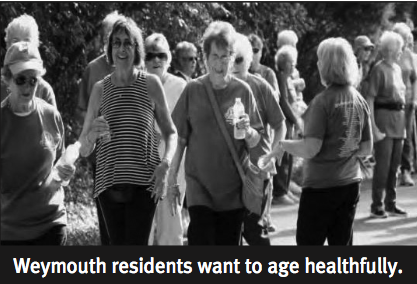
In the summer of 2014, WalkBoston partnered with the Town of Weymouth to open a conversation between municipal staff and older adults about creating a safer, more attractive walking environment. The Safe Routes for Seniors initiative was a true convergence of advocacy and policy, resulting in a set of design guidelines and program alternatives to better coordinate the town’s
capital planning process with greater walkability. The initiative has helped springboard Weymouth toward a healthier approach to community design.

Weymouth is a mature suburban community situated about 12 miles southeast of Boston. The town has a strong residential character with many attributes of a walkable environment. Weymouth has four village centers, each featuring a mix of land uses that helps create a sense of place for residents. It also has a diverse open space network interspersed among many settled neighborhoods. There is also a good mix of transit services, including commuter rail and bus, which help connect Weymouth’s people and places. However, in spite of these attributes, the town has grown increasingly dependent on the automobile for transportation in the last 50 years. Simultaneously, Weymouth’s population has aged and diversified to where almost one in every four residents is over age 60.

Recognizing a need to analyze the built environment from a healthy aging perspective, Weymouth received a grant from the Massachusetts Council on Aging, in partnership with the Massachusetts Department of Public Health [MDPH], to conduct a senior pedestrian safety study. Municipal staff collected data on Weymouth’s housing, land use and pedestrian crashes. The data led the town to identify four areas of need where seniors could most benefit from improved walking conditions.

WalkBoston facilitated a public meeting between municipal staff and an audience of over 30 older adults. Residents raised important concerns about poorly maintained sidewalks, obstructed lines of sight and distressed crosswalks. WalkBoston then hit the streets with a diverse focus group of municipal staff, senior residents and local businesspeople. A wealth of observations were made, and ideas flowed freely between stakeholders.

Weymouth’s walkability investigation culminated in the publication of the Safe Routes for Seniors Design Guidelines and Planning Report. WalkBoston introduced municipal staff to new and innovative approaches to streetscape improvements, including “lighter quicker cheaper” placemaking, which could facilitate safer, more frequent foot traffic by older adults in the town’s target areas. Weymouth’s planning staff prepared the final report to summarize the initiative’s findings and recommend design guidelines for town planning moving forward.

The Safe Routes for Seniors initiative has already led Weymouth to take a number of steps toward enhancing walkability. For 2015, Weymouth’s Mayor Susan Kay has committed $150,000 to sidewalk improvements and indicated that she will budget up to $250,000 for the same purpose each year thereafter. Plans are also under way by municipal staff to develop a Complete Streets policy and apply for certification under the MassDOT’s new Complete Streets program. In addition, the town has received a technical assistance grant from the MDPH to develop a zoning action plan with the Pioneer Valley Planning Commission [PVPC], a leader in the movement to design healthier communities. The PVPC will advise Weymouth on how to facilitate healthy eating and more physical activity in the community through changes to local zoning provisions, such as reduced parking requirements and site plan review.

This article was featured in our Summer 2015 newsletter. See the full newsletter & past editions here.

——————————————————————————————————————-
Join our Mailing List to keep up to date on advocacy issues.

Like our work? Support WalkBoston – Donate Now!
Connect with us on Twitter and Facebook

image
Blind man walking (and running)!

Blind man walking (and running)!

image

Kyle Robidoux is the Director of  Volunteer & Support Group Services at the Mass. Assoc. for the Blind & Visually Impaired.

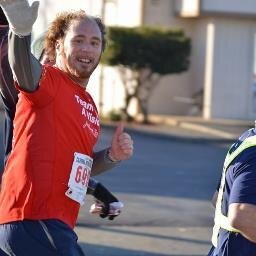
I walk everywhere. As a marathoner, I also run all throughout Boston and neighboring cities.

I’m also legally blind so walking, along with public  transit, is my main mode of transportation. Therefore,  walkability is very important to me and my family.

The walkability of the city and its public infrastructure impacts me every day. It impacts where I walk, how quickly I can get to where I need to be, and most importantly how safely I can get there.

As someone with low vision (I have very restricted central vision, similar to looking through a toilet paper roll), I rely on sidewalks, curb cuts and ramps, and crosswalks to get me safely to where I need to be. I use a white cane most of the time so the quality of sidewalks and streets is very important.

Brick sidewalks are one of the most unfriendly surfaces for me and most folks with limited mobility (I assume most sighted walkers, too). My cane tip frequently gets stuck in a missing brick or I trip because of the unevenness of the sidewalk. Old (some say historic) sidewalks are very common in the South End, where I spend a good majority of my time. If I have a choice, I will avoid going down a street if I know it has terrible brick sidewalks. I’m thankful that the city has set a new policy limiting the amount of brick in the walk path when repairing/installing new sidewalks.

As my eyesight decreases, I am becoming more reliant on audible street crossings. Otherwise, I have to ask someone to help me find the push button. It would be wonderful if more street crossings had regular intervals in which to cross or a “walk signal” triggered by a sensor on the closest curb ramp.

My relationship to the built environment in my neighborhood plays a large factor as my eyesight decreases, especially during the winter. Trying to navigate unshoveled sidewalks and curb cuts blocked by snowbanks is physically and mentally exhausting. I walk my daughter to school along the South Bay Harbor Trail. Sections of the trail were not plowed this winter days after a snowstorm. Some days my daughter and I, along with other students, were forced to walk in the street because the unplowed path was too difficult to walk.

As our communities continue to develop, I hope less time and energy is spent on talking about parking and traffic and more on creating accessible public spaces.

Creating accessible spaces is not only good public policy but will also ensure that they flourish and reach their greatest potential.

This article was featured in our Spring 2014 newsletter. See the full newsletter & past editions here.

——————————————————————————————————————-
Join our Mailing List to keep up to date on advocacy issues.

Like our work? Support WalkBoston – Donate Now!
Connect with us on Twitter and Facebook