Category: Announcement

One in every five traffic deaths in Massachusetts involved a person walking in 2025, new report finds

One in every five traffic deaths in Massachusetts involved a person walking in 2025, new report finds

WalkMassachusetts’ fifth annual report shows older adults and residents in Environmental Justice communities continue to be most affected and calls for action to slow speeds and improve street safety

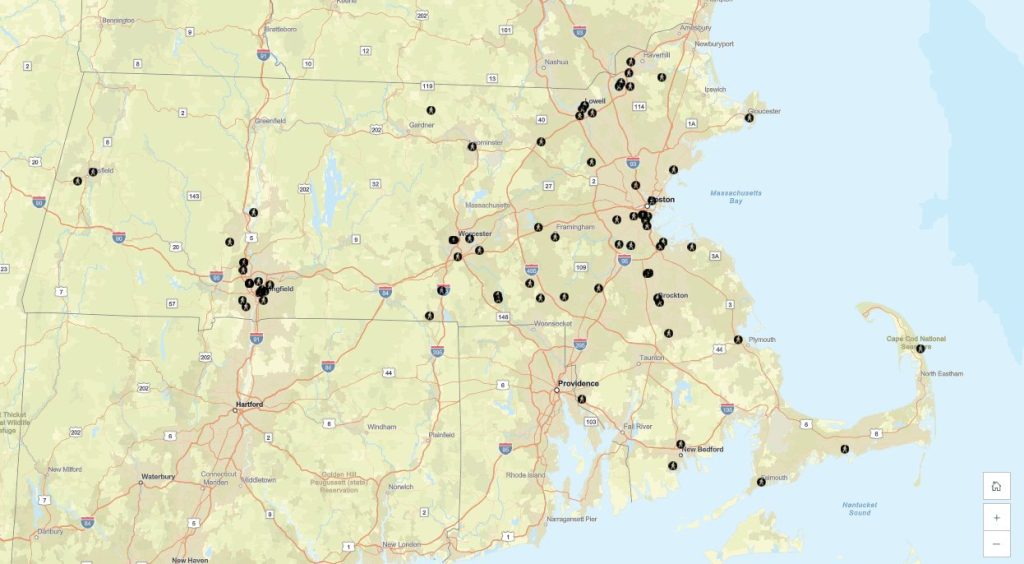
BOSTON, MA (June 17, 2026) – In 2025, one in every five traffic deaths in Massachusetts involved a person walking. Of the 354 total traffic fatalities reported statewide, at least 76 were pedestrians, accounting for more than 21 percent of all deaths.

These findings come from Fatal Pedestrian Crashes in Massachusetts 2025, WalkMassachusetts’ fifth annual report tracking pedestrian fatalities across the Commonwealth. The report draws from MassDOT crash data to examine where, when, and how these crashes occur, and where action is needed to make streets safer.

“We are heartbroken each year as we learn the stories of people walking who lose their lives in crashes that are often preventable,” said Brendan Kearney, executive director of WalkMassachusetts. “One factor continues to show up again and again: speed. Our streets are still designed in ways that allow people to drive too fast, making it harder for drivers to see and safely yield to people walking.”

Key findings include: 

  • 43.4% of people killed while walking were age 65+, despite representing 18.7% of the population 
  • 69.7% of crashes occurred in the dark 
  • 69.7% happened on local streets controlled by a city or town
  • 49 communities experienced a pedestrian fatality, including 13 with multiple deaths 
  • 71.1% of the fatal crash deaths were on roadways with 25- 35 mph speed limits. This does not take into account the speed a person was driving before the crash.
  • 17% of fatalities involved drivers leaving the scene, pointing to ongoing enforcement and accountability challenges 

Older adults continue to be disproportionately impacted. In 2025, 43.4 percent of people killed while walking were age 65 or older, marking the fifth consecutive year this age group has been overrepresented in fatal pedestrian crashes. 

“People of all ages deserve safe and connected infrastructure that accommodates everyone’s needs,” said James Fuccione, executive director of Massachusetts Healthy Aging Collaborative. “While the rates have shifted higher and lower, older adults have been disproportionately impacted in pedestrian fatalities since WalkMassachusetts started compiling these annual reports, and it underscores the need to prioritize aligning age-friendly efforts with planning, policy, and funding programs.”

More than half of pedestrian fatalities continue to occur in Environmental Justice communities, continuing a pattern seen in previous years and reflecting ongoing disparities in roadway conditions and street safety. 

The report also points to gaps in how pedestrian crashes are tracked. For example, deaths that occur more than 30 days after a crash are often not included in official crash data, and inconsistencies in reporting mean some hit-and-run incidents may not be fully captured, making it harder to understand the full scope of the issue.

At the local level, some communities are demonstrating what progress can look like. In Somerville, serious-injury crashes declined by 50 percent in 2025, and the city reported zero traffic fatalities for the third consecutive year, reflecting the impact of sustained Vision Zero efforts and traffic-calming investments such as speed humps.

WalkMassachusetts is calling for renewed momentum in Boston, where pedestrian injuries have increased while some safety efforts have slowed. Fewer than two dozen speed humps were installed last year, compared to more than 600 in 2024. The organization is urging a restart of the City’s Safety Surge program, which uses traffic calming measures such as speed humps, safer intersections, and signal changes to slow speeds and reduce crashes on neighborhood streets. 

To support safer streets statewide, WalkMassachusetts continues to expand its walk audit programs and community partnerships. Upcoming efforts include walk audit trainings in Melrose and Stoneham, as well as collaborations with advocacy groups and municipal leaders in Brockton and Danvers to identify hazards and help move local safety improvements forward. 

WalkMassachusetts is also encouraging residents to suggest safety improvements through the upcoming 2027 Massachusetts Strategic Highway Safety Plan, which MassDOT and the UMass Transportation Center will gather public feedback on this summer. 

“Brockton has recorded at least two pedestrian crash deaths every single year for the past five years, on the very streets where residents walk to work, to the bus stop, to run errands, and go about their daily lives,” said Isabel Lopez, founder and director of Brockton Workers Alliance.  “No one should lose their life just getting where they need to go, especially when this can be prevented. Residents continue to tell us loud and clear that unsafe bus stops, poorly lit streets, and unreliable service are making daily life harder and more dangerous. We’re excited to bring walk audits to Brockton, because the people who navigate these streets every day should have a voice in making them safer.”

WalkMassachusetts is also urging progress on policy solutions such as H.3754, An Act relative to traffic regulation using road safety cameras, which would allow municipalities to opt in to tools like speed and red-light cameras that have been shown to reduce crashes in other states.

Learn more and access the full report at www.walkmass.org/fatal25 

###

About WalkMassachusetts
WalkMassachusetts makes walking safer and easier to encourage better health, a cleaner environment, and more vibrant communities. Founded in 1990 as WalkBoston, the organization envisions a Commonwealth where everyone—regardless of race, age, ability, or identity—feels safe and valued on our streets and sidewalks.

Testimony to joint committee on transportation on S.3077, “An Act to enhance the safe use of micromobility devices” (The Ride Safe Act)

Testimony to joint committee on transportation on S.3077, “An Act to enhance the safe use of micromobility devices” (The Ride Safe Act)

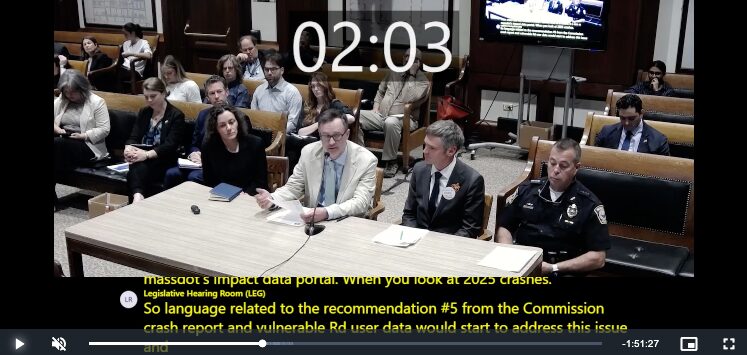
This testimony was shared at a Joint Committee of Transportation Hearing on May 28, 2026 as part of a panel with people that took part in the Micromobility Commission: (L to R) The Ride Cafe’s Kara Oberg, WalkMassachusetts executive director Brendan Kearney, MassBike executive director Galen Mook, and Beverly Police Chief Chief John G. LeLacheur.

My name is Brendan Kearney, and I’m the executive director of WalkMassachusetts, a statewide pedestrian advocacy organization, and our organization was a part of the commission. Thank you to Senator Crighton & Representative Arciero, all other members of the commission (including the rest of this panel), and to the staff at MassDOT who staffed the commission. I’m here in support of S.3077.

The majority of dangerous and fatal crashes in Massachusetts involve vehicles; at least 354 fatal crashes are listed in MassDOT’s IMPACT Data portal from 2025, and each involved at least one motor vehicle. 

One of the discussion points during the commission was that we don’t properly capture or report crashes that do not involve motor vehicles. 

Over the last year there have been some high-profile crashes and deaths involving micromobility devices, including a person walking that was struck by a delivery person using a class 2 e-bike in Boston’s Copley Square last August. That crash did not involve a motor vehicle and, as a result, it is not displayed in MassDOT’s IMPACT Data Portal when looking at 2025 crashes. Language related to Recommendation #5 from the Commission, “Crash Report & Vulnerable User Data,” would start to address this issue, and is included in this proposed bill in Section 23.

With more devices out and about (that will now be defined through this bill!), we should be able to collect data to capture crashes involving micromobility users either alone, with each other, or in crashes with people walking, even if a motor vehicle is not involved. 

I’d also encourage the legislature to look at the additional recommendations that are not included in this bill today and see what can be done to move them this session, or consider what should be prioritized in the near future. I’d like to highlight 3 of the 16 recommendations (starting on page 41), including: 

  • Recommendation 6,  Default Maximum 20mph Speed on Paths:
    This bill starts this process by defining shared use paths. I’d encourage you to take the next step to establish that default max speed. Whoever owns the path retains the authority to lower the limit.
  • Recommendation 8, Automated Enforcement or Safety Cameras:
    This would be for infractions that impact vulnerable users, such as speeding, the improper use of bus and bike lanes, and red light running. There are already bills that have been moving this session; the legislature should pass S.2344 and H.3754 to allow municipalities to opt-in to road safety cameras.
  • Recommendation 12, Funding for Upgrades and Expansion:
    The legislature should increase appropriations for existing state programs, particularly the Complete Streets Funding Program and the Shared Streets & Spaces Program, to further assist municipalities in expanding their networks and moving towards durable, physical separation for vulnerable users and/or overall traffic calming. 

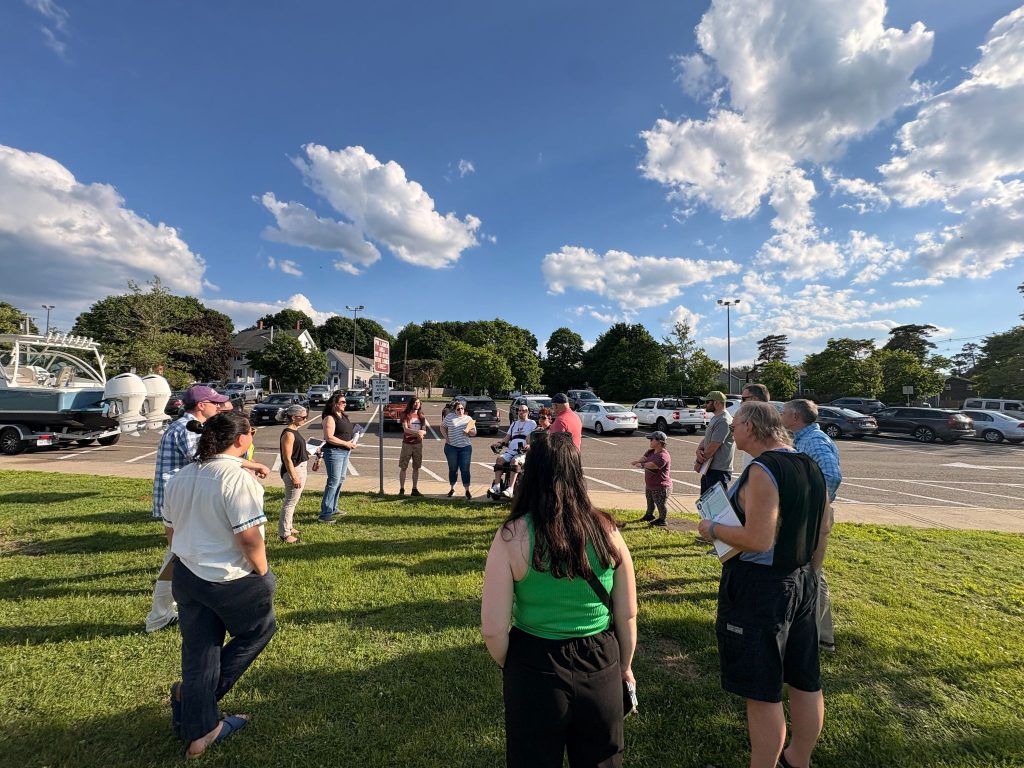
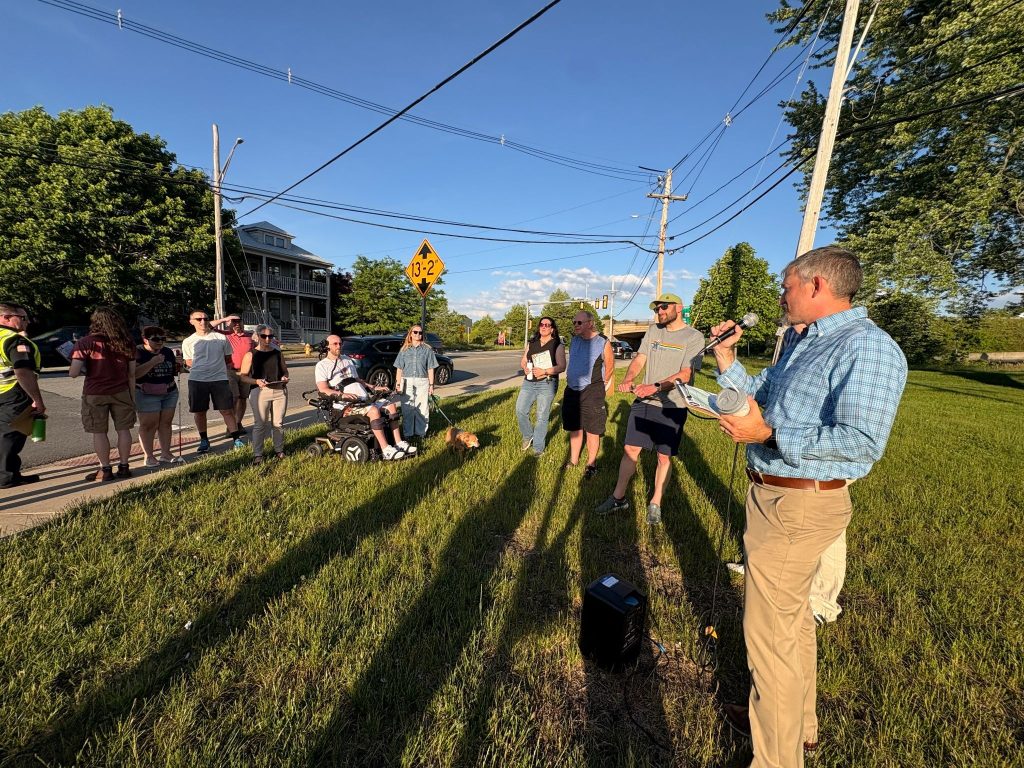
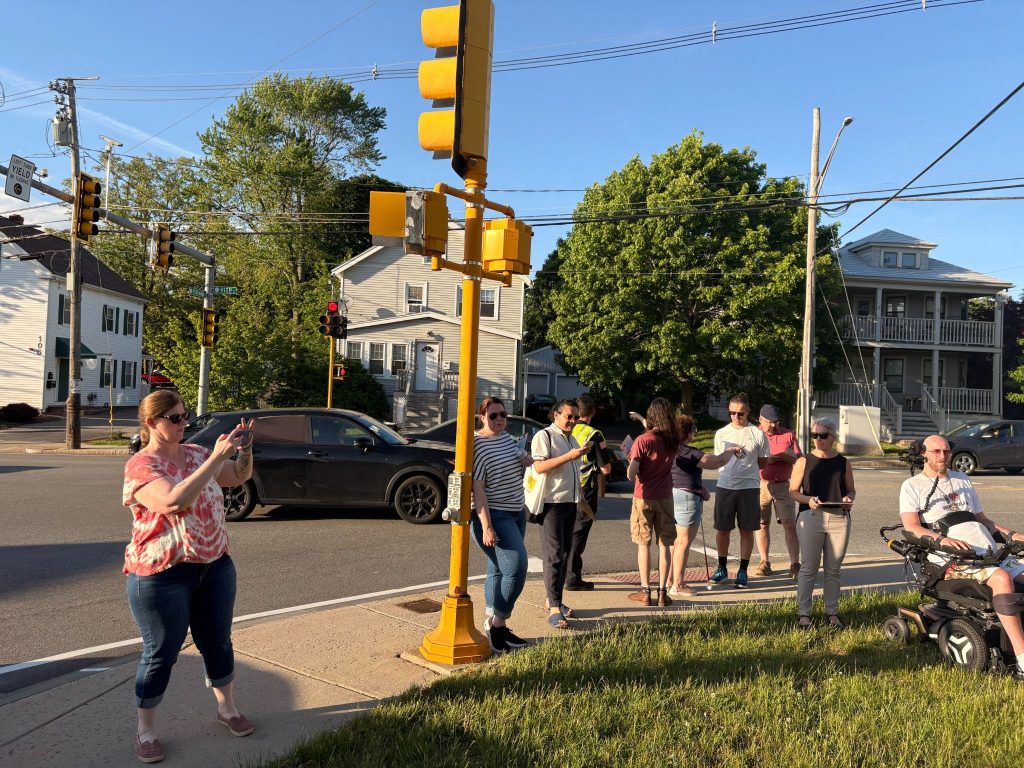
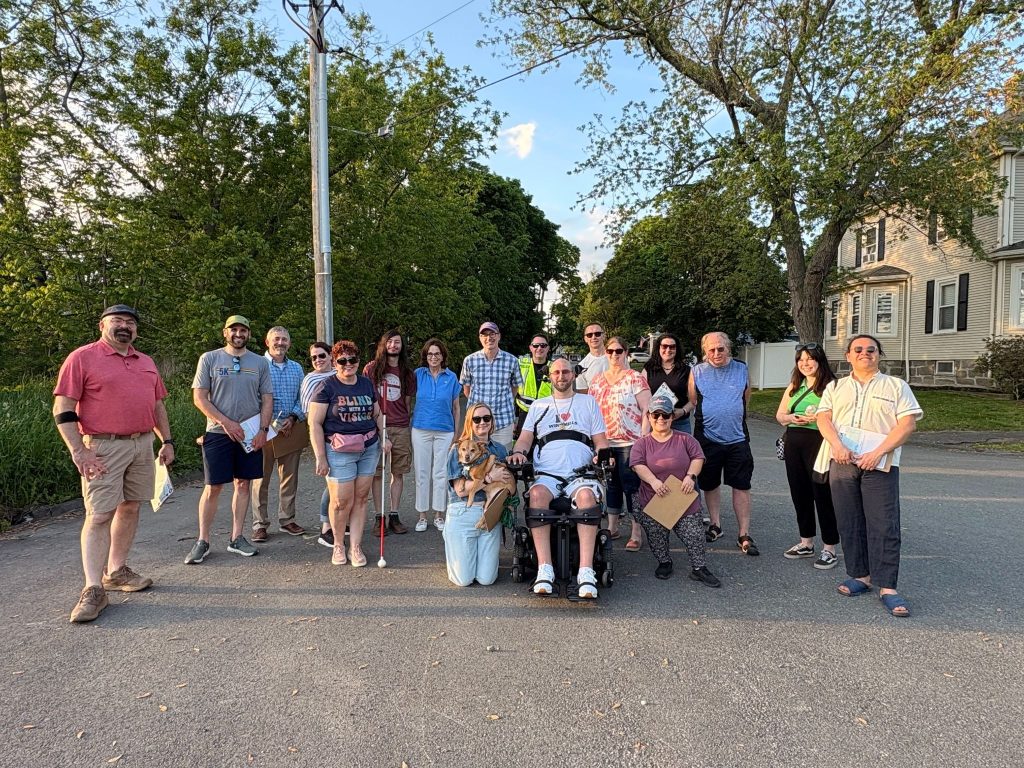
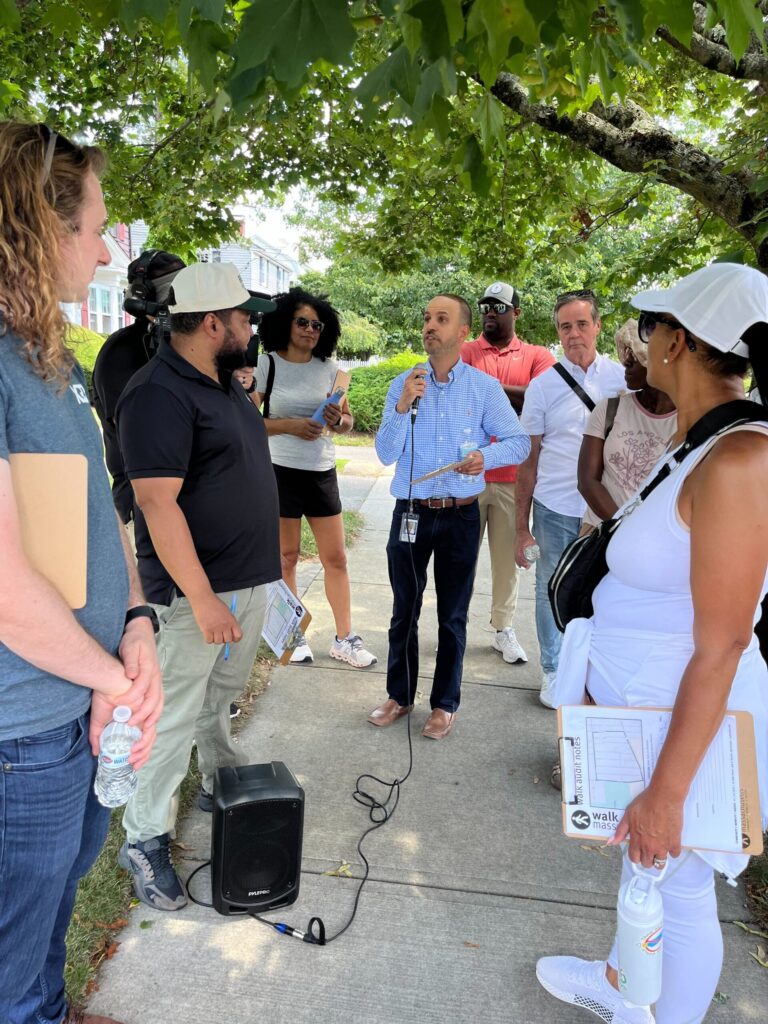
WalkMassachusetts just led a community walk audit in Danvers last night alongside the Danvers Accessibility Commission and Representative Kerans. On it, we encountered kids selling lemonade on High Street, a busy road that connects to Rt 128. They (and their mom) shared that they aren’t allowed to cross High Street near the on/off ramps, but they would love to be able to walk or take their bikes and scooters to the trail which could be extended just 3 blocks away if it was safe to do that. It’d be a shame if their parents had to drive them there. Communities need funding to not just pave and put back what’s out there, but to plan and build for the future. 

Thank you for the opportunity to comment today.

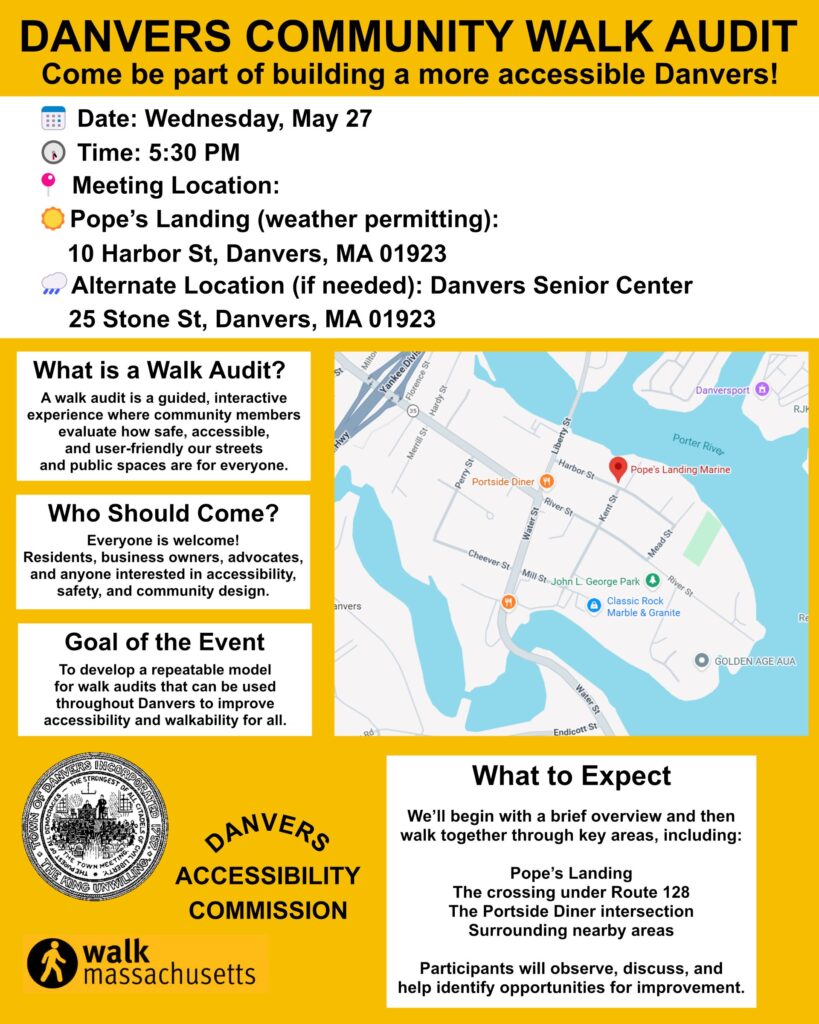
Danvers Community Walk Audit, May 27, 5:30pm

Danvers Community Walk Audit, May 27, 5:30pm

Flyer for Danvers Community Walk Audit, May 27, 5:30pm

Come be part of building a more accessible Danvers! Join WalkMassachusetts & the Danvers Accessibility Commission for a walk audit. WalkMassachusetts believes that community-driven walk audits are a powerful tool for making our roads safer and more accessible for everyone. 

Date: Wednesday, May 27 
Time: 5:30pm 
Meeting location: Pope’s Landing 10 Harbor St, Danvers, MA 01923 (weather permitting).
Alternate location (if needed): Danvers Senior Center, 25 Stone St, Danvers, MA 01923 
RSVP: Sign up now on the Google Form.

What is a walk audit? A walk audit is a guided, interactive experience where community members evaluate how safe, accessible, and user-friendly our streets and public spaces are for everyone. Walk audits are a tool for getting community input about walking conditions based on observation and your own lived experience. 

Who should come? Everyone is welcome! Residents, business owners, advocates, and anyone interested in accessibility, safety, and community design. 

Goal of the event: to develop a repeatable model for walk audits that can be used throughout Danvers to improve accessibility and walkability for all. 

Participants will observe, discuss, and help identify opportunities for improvement. We’ll also discuss climate/sustainability goals and how they might connect to our streets / sidewalk design. This walk audit is part of an Accelerating Climate Resiliency Grant effort funded through MAPC.

We’ll begin with a brief overview and then walk together through key areas, including: 

  • Pope’s Landing 
  • The crossing under Route 128 
  • The Portside Diner intersection 
  • Surrounding nearby areas 

For any questions, contact WalkMassachusetts: staff@walkmass.org 

Want to learn more about the walk audit process beforehand? Learning materials and videos are available on WalkMassachusetts’ website to help you conduct audits in your own community. You can also look at previous walk audits on audits.walkmass.org

Upcoming walk audit trainings: Randolph & Holliston

Upcoming walk audit trainings: Randolph & Holliston

This May, join us for a hands-on Walk Audit Academy training in Randolph (Saturday, May 2) & Holliston (Tuesday, May 5)! This academy is designed to empower municipal staff, community members, and regional stakeholders to identify pedestrian safety and accessibility issues, gather valuable community insights, and advocate for infrastructure improvements. You’ll come out of this training with the knowledge to lead your own walk audit. RSVP today.

This event is part of the Boston Region Vision Zero Action Plan, brought to you by WalkMassachusetts and the Boston Region MPO in partnership with the Town of Randolph (Mass in Motion) and the Town of Holliston. You do not need to live or work in either of these communities to participate in either training / walk audit; we encourage you to attend whichever is more convenient for you. 

We believe that community-driven walk audits are a powerful tool for making our roads safer and more accessible for everyone. Your participation will help inform planning efforts and apply pressure to secure funding for necessary changes.

This builds on a North Shore walk audit training program we offered last winter in Beverly in conjunction with the Beverly Bicycle and Pedestrian Advisory Committee, as well as our Walk Audit Academy videos, a product of WalkMassachusetts and the UMass Worcester Prevention Research Center.

What is a walk audit?

Walk audits are a tool for getting community input about walking conditions based on observation and your own lived experience. This firsthand information can add important detail to more technical information, and help improve traffic safety in your area. 

This training will familiarize you with existing walk audit materials and protocols which will enable you to conduct audits in your own community. Learning materials and videos are also available on WalkMassachusetts’ website. 

Dates & Locations

Randolph Walk Audit Academy
When: Saturday, May 2nd, 9:30am-12pm
Where: starting at Randolph Town Hall, 41 South Main Street, Randolph, MA

Holliston Walk Audit Academy
When: Tuesday, May 5th, 9:30am-12pm
Where: starting at Holliston Town Hall, 703 Washington St, Holliston, MA 01746

Process: We’ll gather for group introductions and a brief learning session(s), then we’ll head outside for a 1 mile walk audit route, and then we’ll return for a group debrief back at our starting location.

These walk audits will take place rain or shine, unless severe weather; the learning and debrief sessions will take place inside each respective town hall building thanks to our local partners.

RSVP for a walk audit training

Whether you’re a municipal staff person, an elected official, part of a municipal bike/ped committee or other volunteer position within your community…or just interested in making your community in Massachusetts safer for walking, we’d love you to join us at one of the walk audit trainings in May!
Please RSVP today.

For any questions that are not answered above:

Reach out to the whole team at WalkMassachusetts (staff@walkmass.org) or Brendan Kearney, our Executive Director (bkearney@walkmass.org). We look forward to seeing you soon!

WalkMassachusetts is a 501c3 nonprofit organization that works to make walking safer and easier in Massachusetts, to encourage better health, a cleaner environment, and more vibrant communities; consider supporting our efforts with a donation. 

Enough with the snow: We deserve clear sidewalks

Enough with the snow: We deserve clear sidewalks

When the mega-snowstorm ended on January 26, we were all asked to be patient. Plow crews were working around the clock; in the meantime, we should do our part by clearing the sidewalks and curb cuts along our homes and businesses.

Maybe with the next storm, #Boston can concentrate just a tad more on crosswalks in what is allegedly America's most walkable citywww.universalhub.com/2026/maybe-n… #snow

— Universal Hub (@universalhub.com) 2026-02-01T01:16:43.753Z

Yet remarkably few property owners actually cleared the 3-foot-wide paths required by local ordinances. Those who ventured out found many sidewalks full of snow or with just narrow paths cleared, and tall snowbanks often blocking passage. Crossing streets was particularly perilous, as few curb cuts were cleared, and just reaching the crosswalk often required squeezing between traffic and tall piles of snow and ice, hoping for the best.

Parents with infants in strollers, older adults, and people with disabilities or limited mobility? They couldn’t go out at all. More than 35 years after passage of the Americans with Disabilities Act, our communities had apparently decided it was OK to just trap them at home.

On February 1, six full days after the end of the storm, this travesty cost a 57-year-old woman her life. She and a companion were walking along Cranberry Highway in Wareham, a two-lane road. The sidewalk wasn’t cleared, so they had to walk on the road. She was using a walker. A motorist came around a bend and saw them in his path, but couldn’t avoid hitting them due to an oncoming vehicle.

It’s a miracle that we haven’t had more casualties, because over 10 days since the storm ended, sidewalks across Massachusetts are still blocked and dangerous. But it seems like officials have decided to let nature clear the remaining snow and ice, when it gets around to it.

Enough already. This is a matter of basic public safety, and it’s a matter of justice. 

When snow isn’t cleared promptly and effectively from sidewalks, we’re all forced to navigate around snow piles, try to avoid ice, and often walk alongside cars just to go about our lives and meet basic needs. It’s scary and dangerous for healthy adults, nerve-wracking for parents with small children, and simply impossible for the most vulnerable members of our communities.

Worst of all, it’s this way by design.

Municipalities and the Mass. Department of Transportation take care of clearing roads, but for the most part, sidewalks are the responsibility of property owners. The fact that many property owners are not physically capable of clearing 2 feet of snow, especially after a municipal plow has piled ice and slush on top of it, doesn’t seem to matter. (Indeed, many street corners have been left with such huge snow and ice piles that only a plow truck could clear them.)

Our local leaders also seem to forget that especially in cities, there are large numbers of rental properties. It’s great that state law protects tenants from being saddled with snow-clearing responsibilities – but no, a landlord who lives in Framingham isn’t likely to show up with a shovel at his Everett triple-decker. Not unless there are real consequences.

As Angie Schmitt, author of Right of Way: Race, Class, and the Silent Epidemic of Pedestrian Deaths in America, put it: “It’s one of the more remarkable double-standards – or inequities – in transportation. Clearing streets of snow is a non-negotiable priority for public agencies, but safe routes for pedestrians are left to a piecemeal private system that mostly fails.”  

It doesn’t have to be this way.

Massachusetts isn’t as snowy as it used to be, but we still have winter every year. Buying snowblowers or small plows to clear sidewalks, at least in high-traffic areas such as business districts, near schools, and around MBTA stations, makes plenty of sense. The equipment can also be used to clear protected bike lanes, many of which are still blocked.

The walk leading into Sullivan isn't cleared either. I guess at least it's not a snow pile, just completely ignored.

— Joan Liu (@joanliu.bsky.social) 2026-02-01T13:59:12.106Z

Actual enforcement of snow-clearing requirements would also help. Municipalities can show some compassion and understanding when there are exigent circumstances, but how many property owners whose stretch of sidewalk remains dangerous have still to be fined?

Municipalities also know which properties have been the subject of repeated complaints, and can reach out to them proactively before storms, warning the owners to avoid further fines.

Small grants to neighborhood associations and local nonprofits could also help them buy snowblowers for shared use – an efficient use of resources and a big help after major storms. Grants could also support low-cost neighborhood shoveling services.

A recent Globe editorial highlighted Somerville’s municipal shoveling assistance program, which matches seniors and people with disabilities with local teenagers. It’s a nice idea, but just 62 homes are enrolled – in a city of 82,000 people. Residents have to register in person at City Hall and fill out a background check form. It shouldn’t have to be this difficult. At WalkMassachusetts, we’re agnostic on solutions: try different things and see what works best. But get those sidewalks cleared, and do not let this happen again! 

Marion Davis is a board member of WalkMassachusetts and lives in Somerville. 
Brendan Kearney is executive director of WalkMassachusetts and lives in Framingham.