To Build Walkable Communities, We Must Make It Easier to Build
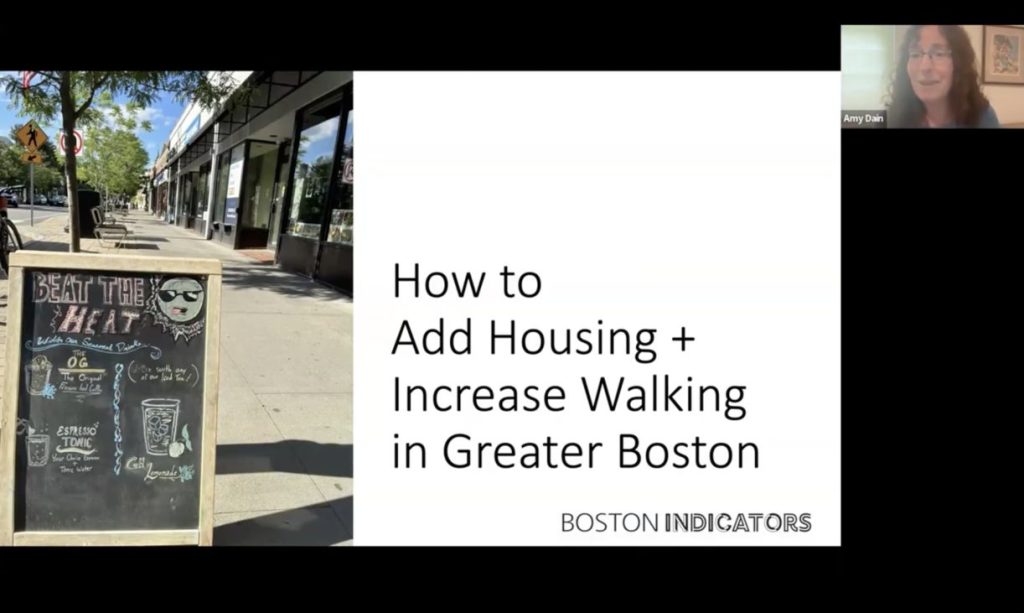
Walkable, connected neighborhoods were created not by chance but were built, brick by brick and bylaw by bylaw, through a century of deliberate land use decisions that determined not just where housing goes, but who gets to live there. During June’s WalkMassachusetts Network meeting, Boston Indicators Senior Fellow and housing and zoning expert Amy Dain laid out a simple, urgent framework. If Massachusetts wants to address housing supply and affordability while strengthening walkability, it has two core strategies: adding housing to neighborhoods that are already walkable, and adding housing to existing neighborhoods while simultaneously making them more pedestrian-friendly. Both matter, but as Dain made clear, one is much easier than the other. Using her own Newtonville neighborhood five years after the passage of the MBTA Communities Act as a case study, she showed how multi-family housing near transit, shops, and schools creates more than homes. It creates the density that keeps local businesses alive, supports transit, and makes walking a practical part of everyday life.
The biggest obstacle, Dain argued, is often not design but engagement. Hyperlocal public hearings and discretionary zoning can turn every housing proposal into a referendum on neighborhood concerns: traffic, flooding, parking, neighborhood change, among others. Those concerns are real, but Dain noted how they can create a system that lets legitimate neighborhood concerns, voiced by those already housed, crowd out the broader regional need for more homes. Massachusetts’ 2021 MBTA Communities Act is one attempt to change that by requiring multifamily housing near transit to be allowed “by-right,” reducing barriers to the kinds of small-scale infill, accessory dwelling units, and mixed-use projects that can gently grow our walkable centers. If we want more walkable communities, we need to make it easier to build in them.
Much of today’s housing growth is happening in strip malls, office parks, and highway corridors, the very places least designed for walking. These sites are huge opportunities if we plan holistically. Rail trail connections, wider sidewalks, shade trees, bus service, safer crossings, and less parking sprawl all can be part of the equation for addressing housing and walkability. To learn more, you can find Amy Dain’s presentation at this link.
Blog post by Marc Armena, Summer 2026 Intern for WalkMassachusetts.