Tag: snow removal

Enough with the snow: We deserve clear sidewalks

Enough with the snow: We deserve clear sidewalks

When the mega-snowstorm ended on January 26, we were all asked to be patient. Plow crews were working around the clock; in the meantime, we should do our part by clearing the sidewalks and curb cuts along our homes and businesses.

Maybe with the next storm, #Boston can concentrate just a tad more on crosswalks in what is allegedly America's most walkable citywww.universalhub.com/2026/maybe-n… #snow

Universal Hub (@universalhub.com) 2026-02-01T01:16:43.753Z

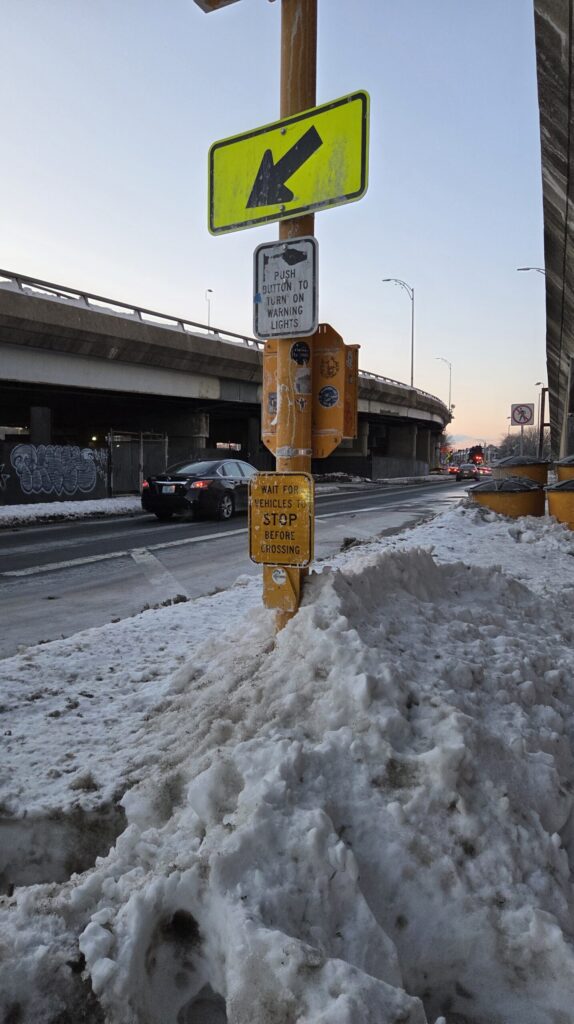
Yet remarkably few property owners actually cleared the 3-foot-wide paths required by local ordinances. Those who ventured out found many sidewalks full of snow or with just narrow paths cleared, and tall snowbanks often blocking passage. Crossing streets was particularly perilous, as few curb cuts were cleared, and just reaching the crosswalk often required squeezing between traffic and tall piles of snow and ice, hoping for the best.

Parents with infants in strollers, older adults, and people with disabilities or limited mobility? They couldn’t go out at all. More than 35 years after passage of the Americans with Disabilities Act, our communities had apparently decided it was OK to just trap them at home.

On February 1, six full days after the end of the storm, this travesty cost a 57-year-old woman her life. She and a companion were walking along Cranberry Highway in Wareham, a two-lane road. The sidewalk wasn’t cleared, so they had to walk on the road. She was using a walker. A motorist came around a bend and saw them in his path, but couldn’t avoid hitting them due to an oncoming vehicle.

It’s a miracle that we haven’t had more casualties, because over 10 days since the storm ended, sidewalks across Massachusetts are still blocked and dangerous. But it seems like officials have decided to let nature clear the remaining snow and ice, when it gets around to it.

Enough already. This is a matter of basic public safety, and it’s a matter of justice. 

When snow isn’t cleared promptly and effectively from sidewalks, we’re all forced to navigate around snow piles, try to avoid ice, and often walk alongside cars just to go about our lives and meet basic needs. It’s scary and dangerous for healthy adults, nerve-wracking for parents with small children, and simply impossible for the most vulnerable members of our communities.

Worst of all, it’s this way by design.

Municipalities and the Mass. Department of Transportation take care of clearing roads, but for the most part, sidewalks are the responsibility of property owners. The fact that many property owners are not physically capable of clearing 2 feet of snow, especially after a municipal plow has piled ice and slush on top of it, doesn’t seem to matter. (Indeed, many street corners have been left with such huge snow and ice piles that only a plow truck could clear them.)

Our local leaders also seem to forget that especially in cities, there are large numbers of rental properties. It’s great that state law protects tenants from being saddled with snow-clearing responsibilities – but no, a landlord who lives in Framingham isn’t likely to show up with a shovel at his Everett triple-decker. Not unless there are real consequences.

As Angie Schmitt, author of Right of Way: Race, Class, and the Silent Epidemic of Pedestrian Deaths in America, put it: “It’s one of the more remarkable double-standards – or inequities – in transportation. Clearing streets of snow is a non-negotiable priority for public agencies, but safe routes for pedestrians are left to a piecemeal private system that mostly fails.”  

It doesn’t have to be this way.

Massachusetts isn’t as snowy as it used to be, but we still have winter every year. Buying snowblowers or small plows to clear sidewalks, at least in high-traffic areas such as business districts, near schools, and around MBTA stations, makes plenty of sense. The equipment can also be used to clear protected bike lanes, many of which are still blocked.

The walk leading into Sullivan isn't cleared either. I guess at least it's not a snow pile, just completely ignored.

Joan Liu (@joanliu.bsky.social) 2026-02-01T13:59:12.106Z

Actual enforcement of snow-clearing requirements would also help. Municipalities can show some compassion and understanding when there are exigent circumstances, but how many property owners whose stretch of sidewalk remains dangerous have still to be fined?

Municipalities also know which properties have been the subject of repeated complaints, and can reach out to them proactively before storms, warning the owners to avoid further fines.

Small grants to neighborhood associations and local nonprofits could also help them buy snowblowers for shared use – an efficient use of resources and a big help after major storms. Grants could also support low-cost neighborhood shoveling services.

A recent Globe editorial highlighted Somerville’s municipal shoveling assistance program, which matches seniors and people with disabilities with local teenagers. It’s a nice idea, but just 62 homes are enrolled – in a city of 82,000 people. Residents have to register in person at City Hall and fill out a background check form. It shouldn’t have to be this difficult. At WalkMassachusetts, we’re agnostic on solutions: try different things and see what works best. But get those sidewalks cleared, and do not let this happen again! 

Marion Davis is a board member of WalkMassachusetts and lives in Somerville. 
Brendan Kearney is executive director of WalkMassachusetts and lives in Framingham. 
WalkBoston Comments on 2022 MassDOT Snow and Ice Control Program EEA#11202

WalkBoston Comments on 2022 MassDOT Snow and Ice Control Program EEA#11202

February 6, 2023

Secretary Rebecca Tepper
Executive Office of Energy and Environmental Affairs

Attn via email: Eva Vaughan

Re:  2022 MassDOT Snow and Ice Control Program EEA#11202

Dear Secretary Tepper:

WalkBoston commented on MassDOT’s Environmental Status and Planning Report (ESPR) on Snow and Ice Control in 2018 and again in March 2021. Our 2021 comments were incorporated into the Certificate issued by EOEEA in 2021.

WalkBoston has continued to follow MassDOT’s efforts regarding the clearance of sidewalks, curb ramps and traffic islands that are under the agency’s jurisdiction, and we are pleased that the 2022 ESPR includes several new commitments to sidewalk snow clearance.

One important step that MassDOT has taken since 2021 is the provision of grant funding of up to $50,000 to help municipalities purchase snow removal equipment for pedestrian and bicyclist facilities through its Shared Streets and Spaces Grant Program. While not directed to MassDOT owned sidewalks, this program should help to increase sidewalk snow clearance on municipal sidewalks.

As stated on page 15 of the ESPR, approximately 43% of MassDOT roads have adjacent sidewalks amounting to approximately 1,300 miles of sidewalks located mostly in the central village and downtown areas of various communities. The new steps called out by MassDOT in the ESPR (pages ES-5 and 15) are the following:

  • New for the 2022/23 winter, MassDOT plans to hire more “seasonal” snow and ice employees that report directly to MassDOT to help with sidewalk clearing as well as other activities.
  • MassDOT will continue to evaluate vendor reimbursement rates and pay codes to enlist more contractors for sidewalk maintenance services and better reflect the variable snow removal efforts for large storms versus smaller storms.

When MassDOT reports on the outcomes of its 2022 ESPR we ask that the following information be included so that WalkBoston and others can see how successful the new efforts are at providing safe and accessible sidewalks.

  1. Provide a map showing the location of the 1,300 miles of MassDOT sidewalks, and indicate which of these miles were covered by work orders for clearance by MassDOT or its contractors.
  2. Include sidewalk clearance responsibilities in the table showing MassDOT SICP roles and responsibilities (Table 1.2 on page 6 of the report)
  3. Provide information about the cost of sidewalk snow clearance provided by MassDOT or its contractors – similar to that provided in Table 1.9 for lane miles.

We look forward to continuing to work with MassDOT on this important public safety and mobility issue.

Best regards,

Brendan Kearney

Deputy Director of Advocacy, WalkBoston

Continued emphasis on snow clearance for pedestrians!

Continued emphasis on snow clearance for pedestrians!

MassDOT’s recently published Snow and Ice Control Program details many of the steps that MassDOT will take to deal with the impacts of its application of chemicals on roadway, a required filing to the Massachusetts Executive Office of Environmental and Energy Affairs (EEA). 

In 2021, WalkBoston urged regulators to require MassDOT to include specific, trackable and verifiable progress toward meeting the scope of pedestrian needs in its next filing on the MassDOT Snow and Ice Control Program, and to use its own Pedestrian Plan commitments as the baseline for reporting. 

At the end of December 2022, MassDOT released an update, which includes these passages: 

  • “Chapter 1 provides an update on MassDOT’s roadway lane-miles and describes new measures to build capacity to address the snow and ice removal needs on sidewalks and pedestrian facilities as identified in the 2019 Pedestrian Transportation Plan and as requested by the WalkBoston following review of the 2022 ESPR SOW Plan.”
  • “New for the 2022/23 winter, MassDOT plans to hire more ‘seasonal’ snow and ice employees that report directly to MassDOT to help with sidewalk clearing as well as other activities. MassDOT will continue to evaluate vendor reimbursement rates and pay codes to enlist more contractors for sidewalk maintenance services and better reflect the variable snow removal efforts for large storms versus smaller storms. MassDOT also provides grant funding of up to $50,000 to help municipalities purchase snow removal equipment for pedestrian and bicyclist facilities through its Shared Streets and Spaces Grant Program. Details on eligible projects can be found at the following link: https://www.mass.gov/shared-streets-and-spaces-grant-program

We are pleased that MassDOT has made new commitments to improve their maintenance of state owned sidewalks. WalkBoston will follow up with MassDOT at the end of the 2022/23 winter season to learn how the new initiatives have been carried out, whether they have proved successful, and to find out whether the agency will plan any additional adjustments to continue making improvements. Check out the links below to read the report for yourself!

Documents

Boston.com: “Should the city remove snow from sidewalks, just like it does for Boston’s streets?”

Boston.com: “Should the city remove snow from sidewalks, just like it does for Boston’s streets?”

Boston.com: “Should the city remove snow from sidewalks, just like it does for Boston’s streets?

Brendan Kearney, deputy director of WalkBoston, an advocacy organization aimed at making walking easier and safer in Massachusetts, told officials Cambridge has taken up efforts, as have Newton and Framingham to varying degrees. “There are definitely examples here in Massachusetts as well,” Kearney said.

Representatives from WalkBoston and the LiveableStreets Alliance — which advocates for safe streets — advised Boston councilors to consider areas to prioritize snow clearing based on community input, and to include sidewalk plowing and direction on where to leave snow piles as part of its snow plow contracts, among other recommendations.

“I’m just super impressed by what Syracuse is doing,” Kearney said. “That is a great, great model for Boston.”

Posted March 18, 2021

View the presentation we shared with the city council:

MassDOT Snow and Ice Control Program Comment Letter

MassDOT Snow and Ice Control Program Comment Letter

March 12, 2021

Secretary Kathleen A. Theoharides
Executive Office of Energy and Environmental Affairs
Attn via email: Eva Murray

Re:  MassDOT Snow and Ice Control Program EEA#11202

Dear Secretary Theoharides:

WalkBoston commented on MassDOT’s Environmental Status and Planning Report (ESPR) on Snow and Ice Control in 2018 and has continued to follow the agency’s efforts regarding the clearance of sidewalks, curb ramps and traffic islands that are under MassDOT’s jurisdiction. While we do believe that MassDOT’s staff agree that sidewalk snow clearance is an important safety, equity and mobility issue, we are disappointed in their lack of progress since 2018.

Our comments reiterate this importance and report on some of the work that WalkBoston has done to urge MassDOT to take more effective planning and operational steps.

As laid out by MEPA in 2018 (page 4), MassDOT’s scope relative to sidewalks was as follows:

“The DSW for the 2022 ESPR should include a response to comments received on the FESPR. In its comments on the DESPR, WalkBoston requested that the ESPR include more information about snow and ice control measures for pedestrian facilities. The FESPR noted that MassDOT will soon complete a statewide Pedestrian Transportation Plan that will include recommendations for improving pedestrian conditions affected by snow and ice. Consistent with MassDOT’s policy to promote alternate modes of transportation, including walking and bicycling, and implementation of its Complete Streets design program, the 2022 ESPR should provide a summary of the findings and recommendations of the Pedestrian Transportation Plan and describe any snow and ice control measures that will be implemented by MassDOT to improve pedestrian conditions. The DSW for the 2022 ESPR should identify any additional analyses or tracking of salt use associated with pedestrian facilities that will be included in the ESPR consistent with the scope and purpose of the SICP ESPRs.”

The Statewide Pedestrian Transportation Plan was completed in 2019 and very clearly called out sidewalk snow clearance as critically important, and as one of the responsibilities for MassDOT to lead on as a transportation and equity issue. It also stated that MassDOT needs to assume responsibility for sidewalk snow removal for some roadways that are under MassDOT’s direct care and control. The text of the Plan which describes these responsibilities is shown below (highlights provided by WalkBoston).

Introduction

With its abundance of historic town centers, compact neighborhoods, urban areas, and natural resources, Massachusetts is home to premier walking environments. However, conditions for walking vary widely from one place to another. A simple stroll can quickly turn challenging or even impossible in the face of discontinuous sidewalks, missing curb ramps, unplowed snow, or unsafe intersections.

Principles

Prioritize improvements for people walking by proactively addressing gaps and barriers that discourage walking and are known to increase likelihood of crashes. MassDOT shall address deficiencies– from sidewalks gaps and missing crosswalks, access to transit, and snow and ice removal, for example.

Initiatives

Initiative 5: Launch a year-round maintenance and operations plan for MassDOT-owned pedestrian facilities and support municipalities to do the same.

Year-round maintenance of pedestrian facilities ensures the continual comfort and safety of the people who use them, but also extends the lifespan of the facilities themselves. MassDOT has a comprehensive process for inventorying the condition of curb-to-curb roadway pavement and for clearing snow and ice on all roadways and bridges travelled by vehicles. This initiative establishes actions to add pedestrian facility maintenance and operations to this work. MassDOT is moving towards a proactive and systematic data collection strategy to identify facilities in need of attention. MassDOT has already gathered data on curb ramp condition as part of the Statewide ADA Transition Plan.

Actions

Action 2: Pilot a winter snow and ice removal initiative on pedestrian facilities in order to provide the basis for development of a comprehensive plan – and an understanding of potential barriers to make such a program permanent.

Measures for tracking progress (on Actions)

Note: Part of the initiative is defining the maintenance standards and operational plans for snow and ice removal that will apply to these measures.

  • Percentage of MassDOT pedestrian facilities that are covered by regular snow and ice operations
  • Equity check: Do certain populations live in areas where fewer pedestrian facilities are covered by regular snow and ice operations?

The Plan outlines significant and important attention to sidewalk snow and ice removal, and we applaud the Plan. However, MassDOT’s efforts to date have not improved sidewalk snow clearance rates on MassDOT-owned facilities. Our March 1, 2021 letter to MassDOT Highway Administrator Jonathan Gulliver is included below and outlines our disappointment in the progress since the 2019 Plan.

Specific comments regarding the Status Report that MassDOT submitted to MEPA in February 2021 

Page 2, Section 1.2 Organization and Format – We are disappointed that sidewalks are not called out here as a section and not mentioned as one of the issues to be addressed.

Section 2.1 Preliminary responses – A number of the preliminary responses are quite specific and note progress toward addressing the issues. Given the specificity of MassDOT’s Pedestrian Plan regarding sidewalk snow clearance, and the requirements in the MEPA Certificate, we think that MassDOT’s answer (shown below) is incomplete and does not accurately characterize the barriers described in a recent presentation by MassDOT to the Massachusetts Bicycle and Pedestrian Advisory Board (a Board established by legislation whose members are appointed by the Governor) where staff indicated that MassDOT had not been able to secure contractors to clear additional sidewalks, or enter into meaningful agreements with municipalities to clear MassDOT-owned facilities.

MassDOT Answer (page 6 of the update)In the last few years, MassDOT has committed additional resources to provide snow and ice control on approximately 10% of the sidewalks adjacent to their roadways focusing on key areas with relatively high pedestrian usage. This effort is in the early stages of development and MassDOT will likely add more sidewalks into its winter maintenance program as resources become available. The status of this effort will be updated in the 2022 ESPR.

Following the MABPAB meeting (January 27, 2021) WalkBoston reached out to MassDOT staff to secure clarification on progress on sidewalk clearance. We followed this up with a letter to the Highway Administrator Jonathan Gulliver and are awaiting his response.

Forwarded message ———

From: Stacey Beuttell <sbeuttell@walkboston.org>

Date: Mon, Mar 1, 2021 at 11:12 AM

Subject: MassDOT Sidewalk Snow Removal Pilot

To: <Jonathan.Gulliver@dot.state.ma.us>

Cc: Jacqueline DeWolfe (DOT) <jacqueline.dewolfe@state.ma.us>

Hi Jonathan. 

I wanted to check in with you regarding MassDOT’s sidewalk snow shoveling pilot program that is now in its second year. Several members of the MassDOT Operations and Maintenance team recently updated MABPAB on the current status of the program and relayed the many barriers that have prevented MassDOT from entering into meaningful agreements with vendors to clear MassDOT-owned sidewalks. They reported that only 8.7% of MassDOT-owned sidewalks are currently being cleared by either MassDOT staff or by contractors. Furthermore, they reported that despite making changes to the sidewalk snow removal RFP this year, no qualified vendors applied for the contract. So, needless to say, people have been unable to walk safely on most MassDOT sidewalks throughout this snowy winter. I’m reaching out to see if there are ways WalkBoston can help with this issue, one that we feel is vitally important for year-round safe walking across the state.

I followed up with Jackie DeWolfe who suggested that I reach out to you. She reiterated MassDOT’s commitment to clearing sidewalks of ice and snow, and suggested that some of the barriers are outside of MassDOT’s control – for example, lack of labor market for sidewalk snow removal; and varying rules and capacities within municipalities to clear sidewalks. WalkBoston is eager and excited to find ways that we can support MassDOT and we are hoping to better understand the contract/municipal agreement issues and to get more sidewalks plowed. What next steps do you suggest we take to better understand the barriers and MassDOT’s work to date to overcome them? I would be happy to set up a Zoom call to discuss these questions with you. 

We know that this is an incredibly complex issue to solve. We know that you are likely as disappointed that the pilot program has now stalled for two snow seasons, as we in the advocacy community are, due to vendor/contract issues. I look forward to talking with you and discussing ways we can support forward movement on this important MassDOT priority.

Thanks Jonathan. I hope you have a good week.

Stacey Beuttell

We urge MEPA to require MassDOT to include specific, trackable and documented progress toward meeting the scope of pedestrian needs in its next filing on the MassDOT Snow and Ice Control Program, and to use its own Pedestrian Plan commitments as the baseline for reporting.

Thank you for the opportunity to comment on this critical issue for the safety, equity and mobility of Massachusetts residents.

WalkBoston would be pleased to answer any questions you may have about our comments.

Sincerely,

Stacey Beuttell                                                                  Wendy Landman
Executive Director                                                           Senior Policy Advisor